

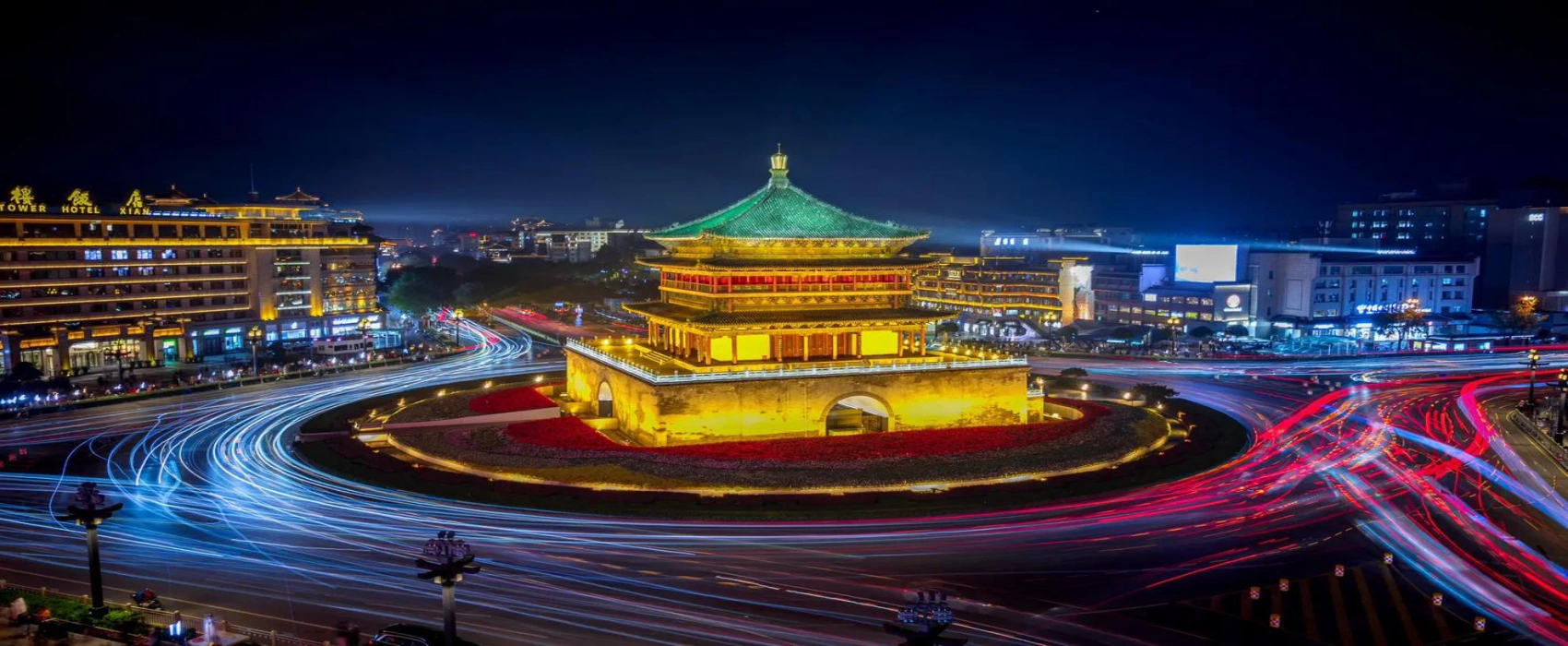

Overview of Xi’an Bell Tower
Location: Downtown Xi’an
Height: 36 meters (118 feet)
Constructed: 1384
Number of Floors: Two
Number of Eaves: Three
1. Xi’an’s Central Landmark
The Bell Tower stands as a majestic traditional structure marking the geographic center of the ancient capital Xi’an. Radiating outward from this significant landmark, four major thoroughfares extend east, south, west, and north, connecting the Bell Tower to the East Gate, South Gate, West Gate, and North Gate of the ancient city walls.

2. The largest and best-preserved structure of its kind in China
In 1384, during the Ming Dynasty (1368–1644), Emperor Zhu Yuanzhang ordered the construction of the Bell Tower to mark the hours, monitor surrounding villages, and warn of enemy invasions. Today, this square wooden structure stands as the largest and best-preserved bell tower of its kind in China.
It sits atop a square brick foundation measuring 35.5 meters on each side and 8.6 meters in height, with a 6-meter-high archway on each side. In the past, vehicles could pass through these arches, but as the city developed and traffic increased, a spacious, well-lit pedestrian underpass was constructed beneath the tower. The entrance to the bell tower is located within this underpass.
comprises two stories yet features three tiers of eaves. These multiple eaves not only enhance the tower’s aesthetic appeal but also effectively reduce rainwater erosion. Inside, a spiral staircase ascends upward. Overall, the gray bricks of its square base, the deep green glazed tiles on the eaves, the gilded roof, and the gold-painted decorations combine to make this tower a magnificent, colorful masterpiece of Ming Dynasty architecture.
3. Bells and the Passage of Time
Approximately 200 meters (220 yards) northwest of the Bell Tower stands its “sister structure”—the Drum Tower. In times past, the bells and drums within both towers would sound daily, marking the passage of time.

4. How did the bell tower mark the hours in the past?
In ancient times, the bell tolled at 5 a.m. each morning, signaling the start of the day and the opening of the city gates. During the day, the bells also chimed at important intervals like 7 a.m. and 11 a.m. Around 7 p.m., the drums sounded 108 beats, signaling the closing of the city gates and the end of the day. At night, drumbeats replaced bells for timekeeping: two beats at 2 a.m., three at 11 p.m., four at 1 a.m., and five at 3 a.m.
5. The Famous Jingyun Bell
When discussing the bells of Xi’an’s Bell Tower, the Jingyun Bell, cast in 711 AD, is absolutely unmissable. This bell bears inscriptions personally inscribed by Emperor Li Dan, the fifth emperor of the Tang Dynasty, making it the only bell in China with an emperor’s calligraphy. Weighing approximately 6 tons, the Jingyun Bell produces a resonant and melodious sound that could be heard throughout the entire city of Chang’an (present-day Xi’an).
Originally positioned in the northwest corner of the Bell Tower, the Jingyun Bell suddenly fell silent during the Ming Dynasty, despite no major events occurring at the time. Later, it was relocated to what is now the Stele Forest Museum in Xi’an. Remarkably, its sound eventually returned. The sound of the Jingyun Bell has been recorded and is now widely used across China. For instance, at midnight on New Year’s Eve during the Spring Festival Gala, the Jingyun Bell is struck to welcome the new year. Today, you can still see an exact replica of the Jingyun Bell on the Xi’an Bell Tower.
6. What else is inside the bell tower?
The interior of the bell tower is equally impressive. The first-floor exhibition hall displays inscriptions chronicling its history, along with ancient architectural components such as glazed tiles and ridge animal sculptures. Looking up, you’ll be captivated by the vibrant circular painted patterns adorning the ceiling. On the second floor, calligraphy and paintings are neatly arranged alongside exquisite porcelain pieces, while the deep-green beams and pillars are adorned with distinctive patterns. Strolling along the side corridors of both floors, you can admire the vivid narrative carvings on the 64 vermilion doors and capture a photo with the Drum Tower to the northwest.

7. The Bell Tower’s Stunning Night View
From 7 PM to 11 PM on weekdays, and from 7 PM to around midnight on weekends and holidays, the Bell Tower glows brilliantly, radiating an even more enchanting beauty. Posing for photos in traditional Hanfu attire against the backdrop of the dazzlingly lit Bell Tower and the bustling traffic around it has become a popular trend.
8. Best Viewing Spots for the Bell Tower
Besides the areas along the roads surrounding the Bell Tower, the observation deck inside Kaiyuan Shopping Center to the southeast also offers excellent vantage points for photographing the tower. If you’re taking the subway to the Bell Tower, choose Exit 4 or 5 of the underground passage to enter the mall. On the second floor, you can use the area behind the red railings for horizontal shots. On the fifth and sixth floors, you can capture stunning panoramic views of the Bell Tower and sunset from a drone’s-eye perspective. On the seventh and eighth floors, the elevated observation decks allow you to photograph both the Bell Tower and Drum Tower together.
To learn more about Shanghai attractions, please contact 365 China Travel consultants.>>>apply now