

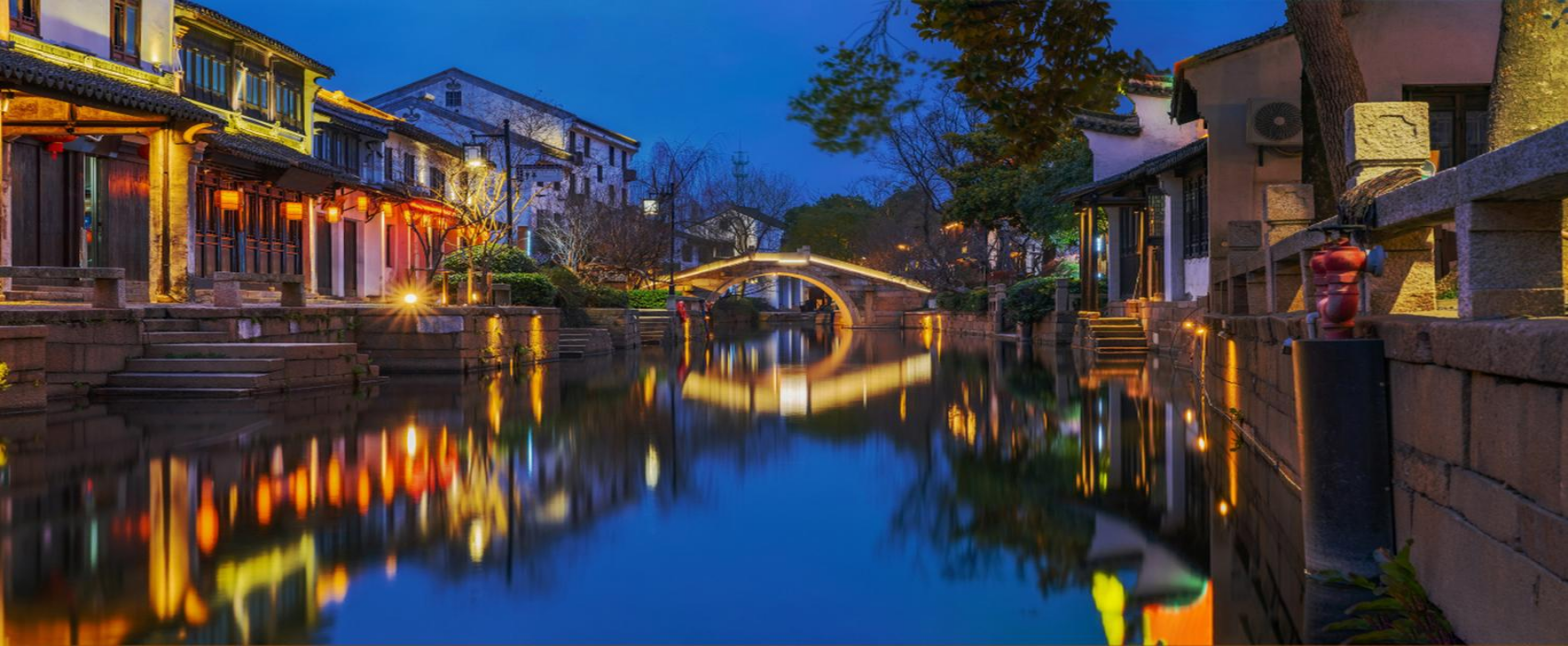

Wuzhen Water Town, located in the northern part of Tongxiang City, Zhejiang Province, is a quintessential ancient town in southern China. It is approximately 80 kilometers (50 miles) from both Hangzhou and Suzhou, and about 140 kilometers (87 miles) from Shanghai.
As one of the six major ancient towns in the southern Yangtze River region, Wuzhen boasts over 6,000 years of history and has long been a fertile land abundant in rice, fish, and silk. It retains its rustic charm to this day, exuding the rich ambiance of a water town. Throughout the town, black-brick, gray-tiled houses contrast beautifully with whitewashed walls, creating scenes reminiscent of traditional Chinese ink paintings. Stone bridges grace the landscape, while black-canopied boats drift gently along the murmuring rivers. Whether strolling along the riverbanks or wandering through alleys paved with blue flagstones, visitors are captivated by the picturesque scenery and the town’s leisurely pace of life.

A crisscrossing river divides the whole Wuzhen Water Town into four scenic sections, which are respectively called as Dongzha, Nanzha, Xizha, and Beizha by local people. Since Nanzha and Beizha are less developed, tourists often prefer to visit Dongzha and Xizha. Dongzha maintains the basic original layout while Xizha has been reconstructed to reproduce the ancient appearance of the water town. Compared with Dongzha, Xizha is more bustling with numerous shops.

1.Xizha in Wuzhen Water Town
In this area, there is a museum which may arouse your interest, the Chinese Foot Binding Culture Museum. In ancient China, women’s feet are called ‘golden lotus’. To make their feet more beautiful, young girls were forced to bind their feet with cloths. Consequently, their feet got distorted, sometimes even could not support them firmly. Many pictures and models showing the scenes are on exhibit in the museum. In addition, the more than 500 hundred shoes in the museum are worth seeing, as they represent the evolution of ancient Chinese shoes.
In Wuzhen Xizha, one may be amazed at the extraordinary scene of Bridge in Bridge created by two ancient bridges, one of which is Tongji Bridge crossing the river from east to west and the other is called Renji Bridge running from south to north and joining the former at one end. Either of two bridges can be seen through the arch of the other. Having been rebuilt five times, Tongji Bridge is a 28.4-meter-long (93.1 feet) and 3.5-meter-wide (11.4 feet) one-curvature arch bridge, with a span of 11.8 meters (38.7 ft). Renji Bridge, which has also experienced historical repairs, has a length of 22.6 meters (74.1 ft), a width of 2.8 meters (9.2 ft) and a span of 8.5 meters (27.9 ft).
There are also other interesting hot spots in Xizha, such as the Xuchang Sauce and Pickle Workshop, a shop selling sauce and pickles produced using traditional techniques, Zhaoming Academy, Temple of General Wu (a heroic general who died there in a battle), and Matchmaker’s Temple.

2.Dongzha in Wuzhen Water Town
Covering an area of 900,000 square meters (9,687,519 square feet), Dongzha scenic section has many tourism attractions. Walking along the ancient street, you will see a museum housing dozens of ancient beds. As the first museum collecting and exhibiting ancient beds in China, its most exquisite collection is the Bed Made by Thousands of Craftsmen. It took more than a thousand of craftsmen three years to make the bed, hence the name.
Another museum which may catch your eyes is the Museum of Folk Customs in Southern Yangtze River Region. It displays local unique birthday ceremony, wedding customs, and folk customs on various festivals. You can learn the interesting life style of local people here. Yu Liuliang Coin Museum, a museum used to display over 26,000 kinds of coins in the past dynasties from about 230 countries and regions is also worth visiting.
Originally built in the central 19th century covering a total area of 650 sq. meters (7,020 square feet), the former residence of Mao Dun, a well-known Chinese revolutionary writer, was the Mao family home for many generations and witnessed the growth of this great revolutionist and writer. In 1984, the former residence of Mao Dun was renovated and extended to cover a total area of 1,731.5 square meters (18,700 sq. ft) – it opened to the public one year later. In 1988, it was listed as one of the Key State Preserved Relic Units and in 1994 was renamed the Mao Dun Museum of the City of Tongxiang. The house has three exhibition areas: ‘Wuzhen, the Hometown of Mao Dun’, ‘the Way of Mao Dun’, and ‘the Former Residence of Mao Dun (renovated)’. The present Mao Dun Museum can be found to the east of the residence, which used to be Lizhi Shuyuan (Aspiration Academy) where Mao Dun spent his early school years.
Enjoying a well-deserved reputation as the best teahouse in the Wuzhen Water Town, the Fanglu Pavilion obtained its name from an accidental meeting between Lu Tong, the owner, and Lu Yu, the Patron Saint of Tea during the Tang Dynasty (618-907). It is said that Lu Yu once mistakenly ate some poisonous leaves and was rescued by Lu Tong, who happened to collect tea leaves at that time. In return, Lu Yun taught Lu Tong knowledge of tea and tea-making skills, which resulted in the prosperity of Lu Tong’s teahouse. Suggested by one guest, Lu Tong changed the house’s name to Pavilion of Visits to Lu (Fanglu Pavilion in Chinese), to memorize this respectable scholar. Located to the south of Ying Bridge and backing onto the city river, the teahouse enjoys a broad view of Guanqian Street and provides visitors with pleasant relaxation.
flower-printed blue cloth workshop, Wuzhen
Blue printed cloth of China is very famous all around the world and Wuzhen is one of its original manufacturing places. Hong Yuan Tai Dye House, first constructed in Nanzha section during Song Dynasty (960-1127) and Yuan Dynasty (1127-1368) and relocated to Dongzha in the reign of Qing Emperor Guangxu (1871-1908), enjoys a good reputation for its blue printed cloth. Watching the process of making blue printed cloth will remind you of the sophisticated craftsmanship of ancient China.

3. Wuzhen Water Town Travel Guide
Nestled along the riverbanks, the ancient town of Wuzhen is most renowned for its diverse fish dishes. However, it also boasts other renowned delicacies such as green rice dumplings, soy sauce braised lamb, and pot-baked bread. As the old saying goes, “When in Rome, do as the Romans do.” Savor local snacks, don a blue-printed cotton skirt, and stroll along ancient lanes under an oil paper umbrella—this will surely become an unforgettable experience in your life. Additionally,
you can participate in numerous folk activities for pure enjoyment, such as the “Long Street Banquet.” Held typically in winter, this event offers visitors from all regions a chance to gather around long tables for lively conversation. Come summer, villagers sell fresh seasonal vegetables and fruits from boats, creating a bustling floating market. Wuzhen,
while steeped in profound Chinese traditional culture, also embraces modernity in certain aspects. Visitors can access free WiFi throughout every corner of Wuzhen’s water town. Moreover, all shops, restaurants, and hotels accept Alipay payments, greatly enhancing convenience for tourists. Since hosting the inaugural World Internet Conference on November 19, 2014, Wuzhen has become the permanent venue for this summit.