


The Summer Palace is China’s largest and best-preserved imperial garden. Its exquisite 18th-century imperial architecture and magnificent lakes and mountains attract millions of visitors from around the world.
1. Harmony Between Architecture and Nature
The artificial structures of the Summer Palace blend seamlessly with the natural slopes and lakes. Grand palaces extend along the mountain ridges as if growing organically from the hills. The expansive lake surface mirrors pavilions and distant peaks, immersing visitors in a vibrant landscape painting.

2. Blending Architectural Styles from Across China
The Summer Palace masterfully integrates architectural styles from different regions of China. Within its grounds, visitors can experience the resplendent grandeur of Beijing’s imperial palaces, feel the tranquil serenity of southern China’s water towns, and encounter the white stone mandalas of Tibetan Buddhism.
3. China’s Only Large-Scale Imperial Garden Preserved in Near-Perfect Condition
In China, the Summer Palace stands as the sole large-scale imperial garden preserved in near-perfect condition. Despite enduring countless wars and upheavals, it still houses approximately 3,000 ancient structures and 40,000 imperial artifacts. This allows visitors to step back in time and witness firsthand the daily life, governance, ceremonial activities, and leisure pursuits of the Qing Dynasty imperial court.

4. Designated as a World Heritage Site and Other Honors
As the pinnacle of classical Chinese gardens, the Summer Palace has received numerous accolades. It was inscribed on the World Heritage List for its exquisite garden artistry and embodiment of Eastern garden philosophy.
Additionally, it holds the status of a National 5A-level Tourist Attraction, meeting China’s highest tourism standards. The Summer Palace is counted among the “Four Great Gardens of China,” alongside the Chengde Mountain Resort, the Humble Administrator’s Garden, and the Lingering Garden in Suzhou.
5. The Four Major Attractions of the Summer Palace: Must-See Destinations
Covering approximately 290 hectares, the Summer Palace primarily consists of Wanshou Mountain and Kunming Lake. Based on its geographical layout and topography, the palace grounds can be divided into four distinct areas: the front section of Wanshou Mountain, the rear section encompassing the mountain’s backside and the rear lake, the courtyard area surrounding the East Palace Gate, and the water scenery of Kunming Lake. Each area possesses its own unique characteristics.
6. Area Before Wanshou Mountain: A Magnificent Buddhist Architectural Complex
The area before Wanshou Mountain at the front of the Summer Palace is the most splendid section of the garden, primarily used for Buddhist ceremonies and imperial celebrations. It stretches from the northern end of Kunming Lake all the way to the summit of Wanshou Mountain.
Strolling along the lakeshore through the exquisitely painted Long Corridor and ascending the steps leads to the central, highest, and most magnificent Hall of Cloud-Dispelling, housing a colossal gilded Bodhisattva statue. Further upward, the towering Fragrant Pavilion stands majestically, offering panoramic views of the Summer Palace’s splendid scenery.

7. Area Behind Wanshou Mountain: Architecture and Mountain Views
Nestled behind Wanshou Mountain, this area features diverse structures and rolling hills that contrast sharply with the grandeur before it, creating a tranquil and serene leisure space.
The red and white palaces and pagodas of the four major zones are built along the slopes, cascading down in tiers, modeled after Tibetan temple architecture; While Suzhou Market Street features white-walled, gray-tiled houses arranged in a charmingly irregular pattern, evoking the riverside towns along the southern bank of the Yangtze River. Additionally, the tranquil Back Lake winds through dense forests, where only birdsong and the gentle murmur of flowing water echo through the air.

8. Kunming Lake Area: Vast Water Scenery
This section occupies three-quarters of the garden’s area, offering expansive views to fully appreciate the beauty of Kunming Lake. Strolling along the East or West Dikes reveals boundless vistas of lake and mountains, with cultural landmarks like the Bronze Ox and Stone Boat serving as highlights.
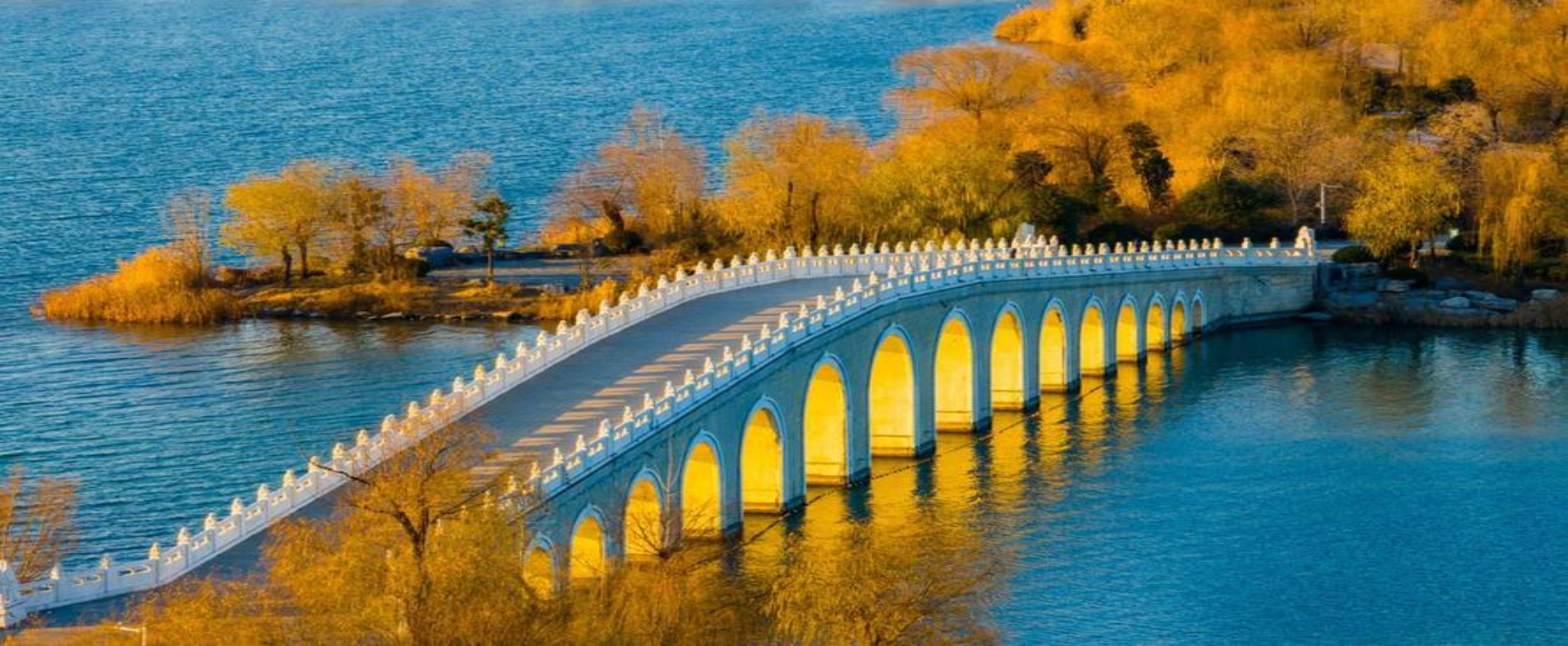
Dotted across Kunming Lake are Nan Island, Caihua Island, and the site of the former Imperial Pavilion, symbolizing the three mythical islands from Chinese folklore. The Seventeen-Arch Bridge spans the lake like a jade sash, connecting Nan Island to the mainland.