

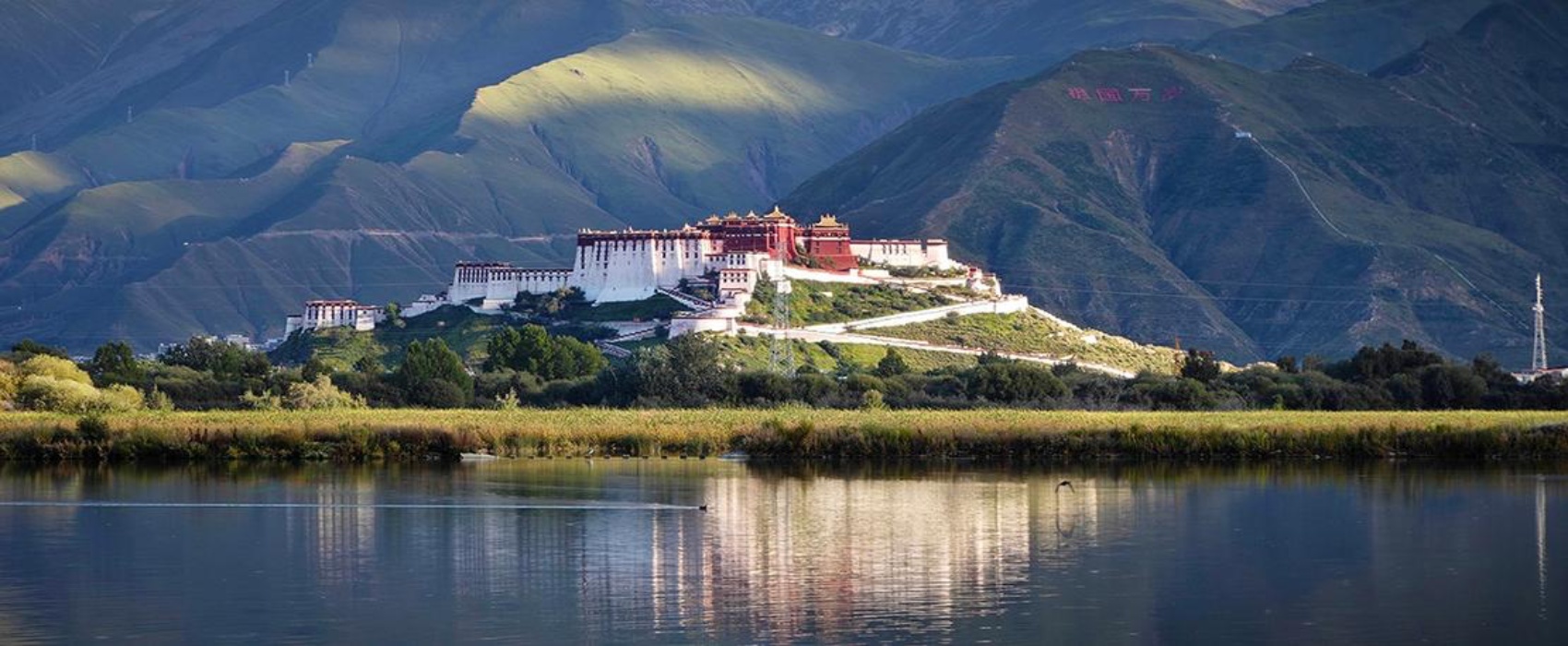

Location: Red Hill, downtown Lhasa
Elevation: Highest point at 3,767.19 meters (12,359.55 feet)
Construction date: 631 AD
The Potala Palace stands as the world’s highest ancient palace. Its name Potala originates from a sacred mountain in South India, meaning “abode of Avalokiteshvara (the Compassionate Buddha)” in Sanskrit. Legend holds that the Potala Palace was built to welcome a Han Chinese princess. In the 7th century, to receive his bride Princess Wencheng of the Tang Dynasty (618-907), the Tibetan king Songtsen Gampo constructed a nine-story palace with a thousand rooms atop Red Hill, naming it Potala Palace. Constructed primarily of stone and timber, the palace was adorned with locally sourced white horsehair grass. Later, following the collapse of Songtsen Gampo’s dynasty, this ancient palace was nearly destroyed in the ensuing turmoil. What we see today is the Qing Dynasty (1644-1911) architecture, along with the results of continuous expansion since the 17th century.
The Potala Palace stands as a symbol of cultural and economic exchange between Tibet and the Tang Dynasty. Today, this palace holds immense historical value and profound significance for China.
The palace complex comprises two main sections: the central Red Palace flanked by the White Palace on either side.

1. The Red Palace of the Potala Palace
The Red Palace (also known as the Potrang Marpo) is the highest structure at the center, dedicated entirely to religious studies and Buddhist prayer. It is painted red, symbolizing solemnity and power. The interior layout of the Red Palace is intricate, comprising multiple-story buildings, chapels, and libraries, interspersed with numerous small corridors and winding passageways. These include the Great West Hall, the Dharma Cave, the Sacred Hall, the tomb of the 13th Dalai Lama, and more. The Western Hall, spanning 725 square meters (approximately 7,804 square feet), is the largest chamber, its walls adorned with exquisite murals. Surrounding the Western Hall are three chapels: the Eastern Chapel, Northern Chapel, and Southern Chapel. The Stupa Cave and Sacred Shrine are the only two surviving 7th-century structures, housing statues of Songtsen Gampo, Princess Wencheng, and Princess Vasistha.

2. The White Palace of the Potala Palace
The White Palace (also known as Potrang Karpo Palace) once served as the administrative headquarters of the Tibetan regional government and is now the residence of the Dalai Lama. Its walls are painted white, symbolizing tranquility and peace. The East Hall on the fourth floor, spanning 717 square meters (approximately 7,718 square feet), was historically the venue for major religious and political ceremonies. The fifth and sixth floors served as the residence and office of the Regent, while the seventh floor, the top level, is the Dalai Lama’s residence. It is divided into the East Sunlight Hall and the West Sunlight Hall, named for their abundant sunlight.

3. Other Annexes of the Potala Palace
The Potala Palace also features other annexes, including Buddhist colleges, monasteries, printing workshops, gardens, courtyards, and even a prison. For over three centuries, this complex has safeguarded numerous cultural relics such as murals, stupas, statues, thangkas, and rare scriptures.
4. Travel Tips
♥The tour route here is strictly regulated; all visitors must enter through the east main gate.
♥Visiting time is limited to one hour.
♥Please note that no restrooms are available along the tour route except for the one on the right side of the White House Plaza. The restroom at the White House’s rear entrance is said to be quite unique and worth trying.
♥Due to the high altitude, please watch your step. The halls may feel slightly chilly and damp; bringing a jacket is recommended.

5. Important Notes
♥No liquids, including beverages and bottled water, are permitted inside the Potala Palace. However, purchases can be made at the summit.
♥Smoking is strictly prohibited within the Potala Palace, and cigarettes are not allowed inside. Violation of this rule will result in ticket invalidation.
♥Oxygen tanks are prohibited.
♥During your visit, please observe Tibetan Buddhist taboos. Do not wear hats or sunglasses; do not step over door thresholds; photography is prohibited inside the palace but permitted outside.