

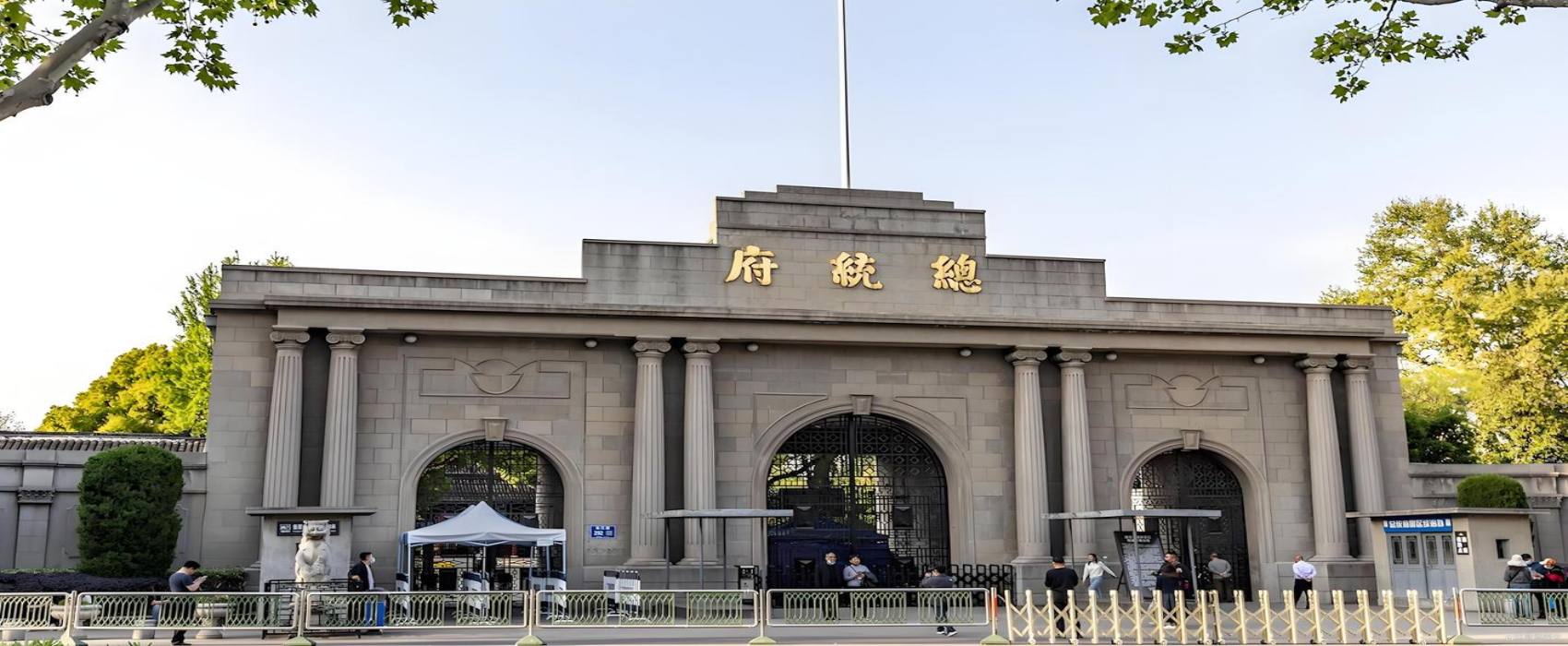

The Nanjing Presidential Palace is located at 292 Changjiang Road in Xuanwu District, Nanjing. Originally built during the Ming Dynasty (1368–1644) as an imperial residence, it now serves as China’s largest museum dedicated to modern history. As a political center, Nanjing has witnessed numerous pivotal moments in ancient and modern Chinese history. Visiting the Nanjing Presidential Palace offers visitors a profound insight into China.
1. History
Since the early Ming Dynasty, this palace served as a residence for imperial family members. During the Qing Dynasty (1644–1911), it became the residence of the Viceroy of Liangjiang, overseeing territories encompassing present-day Jiangsu, Shanghai, Anhui, and Jiangxi provinces. In 1853, Nanjing fell to the Taiping Heavenly Kingdom, and the Heavenly Emperor resided here. In 1911, Sun Yat-sen took the oath of office as Provisional President of the Republic of China at this site. After the founding of the People’s Republic of China, the Nanjing Presidential Palace continued serving as an official venue until the late 1990s, when it was converted into the Museum of Modern Chinese History.
Covering over 90,000 square meters (968,752 square feet), the Nanjing Presidential Palace is divided into three exhibition zones—central, western, and eastern—featuring a total of 11 exhibition halls.

2. Central Section
Waiting rooms are located on the west and east sides, accessible through the Western-style gatehouse reconstructed in 1929. Continuing forward leads to the Grand Hall, a double-eaved structure in classical Chinese style. Though renovated multiple times, it remains well-preserved—for instance, Sun Yat-sen’s inauguration ceremony in 1912 was held in the West Hall behind the Grand Hall. A north corridor connects the Grand Hall, auditorium, and the Late Qing-era Annex Hall, which once served as a reception venue for foreign envoys. Continuing northward past the reception room and Qilin Gate brings you to the Government Administration Bureau, which houses numerous fascinating exhibits. Proceeding further, you will reach the main structure of the Nanjing Presidential Palace, also known as Zichao Building. This five-story structure features administrative offices for civil officials on the first floor, presidential and vice-presidential offices on the second floor, and a conference hall on the third floor.

3. West District (Xuyuan Garden)
Luyuan Garden, situated west of the Nanjing Presidential Palace, is also known as the “West Garden.” As a quintessential southern garden, it features the Stone Boat, Wangfei Pavilion, Ripple Pavilion, and Silver Heart Stele Pavilion. Its most renowned structure is the Provisional Presidential Palace, where the inaugural cabinet meeting of the Provisional Republic of China government convened on January 21, 1912. Subsequently, the site was occupied by multiple military institutions of the Nationalist Government.

4. East Wing
This area once housed administrative offices and now serves as a venue for displaying significant historical documents and records. It frequently hosts exhibitions on diverse themes.