

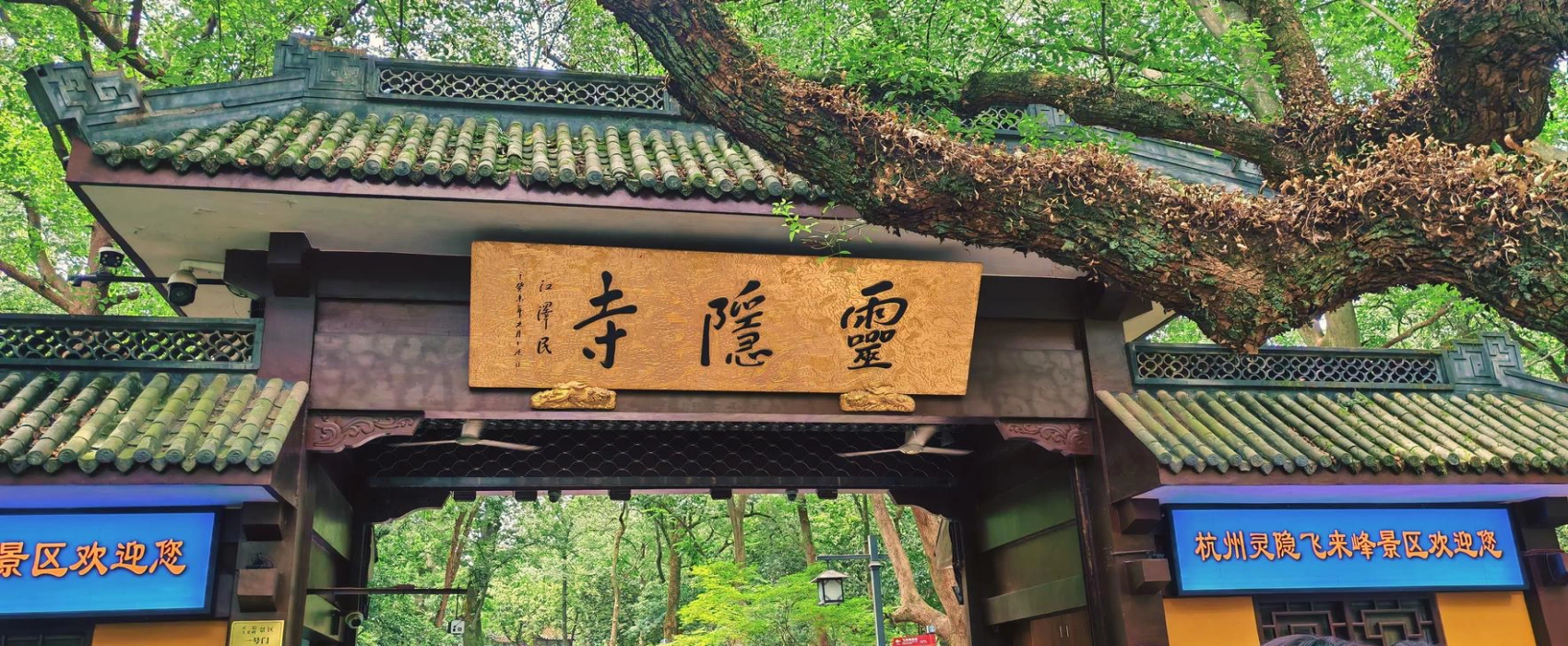

 The Lingyin Temple and Peak Flown from Afar offer free entries from December 1, 2025 on. All tourists need to reserve a ticket at least one day in advance.
Lingyin Temple is situated in a narrow valley between Feilai Peak and North Peak, northwest of West Lake in Hangzhou, Zhejiang Province. It is undoubtedly one of the most dazzling attractions in the West Lake area and ranks among China’s ten most significant Buddhist temples. In 1961, Lingyin Temple was designated a provincial-level key cultural relic protection unit and is regarded as a vital center for the study of Chinese Buddhist culture.

The history of this temple dates back to the Eastern Jin Dynasty (317–420 AD). According to local legend, an Indian monk named Huili arrived here and was so moved by the scenery that he believed it must be the dwelling place of immortals. He thus named the temple “Jingxin Temple.” Because the temple’s serene and beautiful surroundings bring a sense of peace and tranquility, its Chinese name is often translated into English as “Temple of Tranquil Mind” or “Temple of Calm Mind.”
Lingyin Temple rose to prominence during the Five Dynasties period (907–960 AD), when the ruler of Wuyue ordered extensive expansions to demonstrate his devotion to the Buddha. At its peak, Lingyin Temple boasted nine main halls, eighteen pavilions and towers, seventy-seven palaces and chambers, totaling over 1,300 rooms capable of accommodating approximately 3,000 monks. Such a colossal complex is hard to imagine, let alone one that endured centuries of turmoil, suffering through wars, religious persecution, and other calamities. The main structures visible today were reconstructed in 1974, a decade after the Cultural Revolution.
Upon entering the first hall of Lingyin Temple, you will see a plaque inscribed with an inscription by Emperor Kangxi of the Qing Dynasty (1644-1911). Moved by the temple’s mist-shrouded, tree-enveloped setting, he bestowed the name “Temple of Clouds and Mist.” This approximately sixty-foot-tall, double-eaved hall is called the “Hall of the Heavenly Kings.” Above its doors are carved the couplets: “Seated upon the threshold, gazing at distant mountains soaring; With a smile, welcoming spring, snow melts and streams reappear.”
