

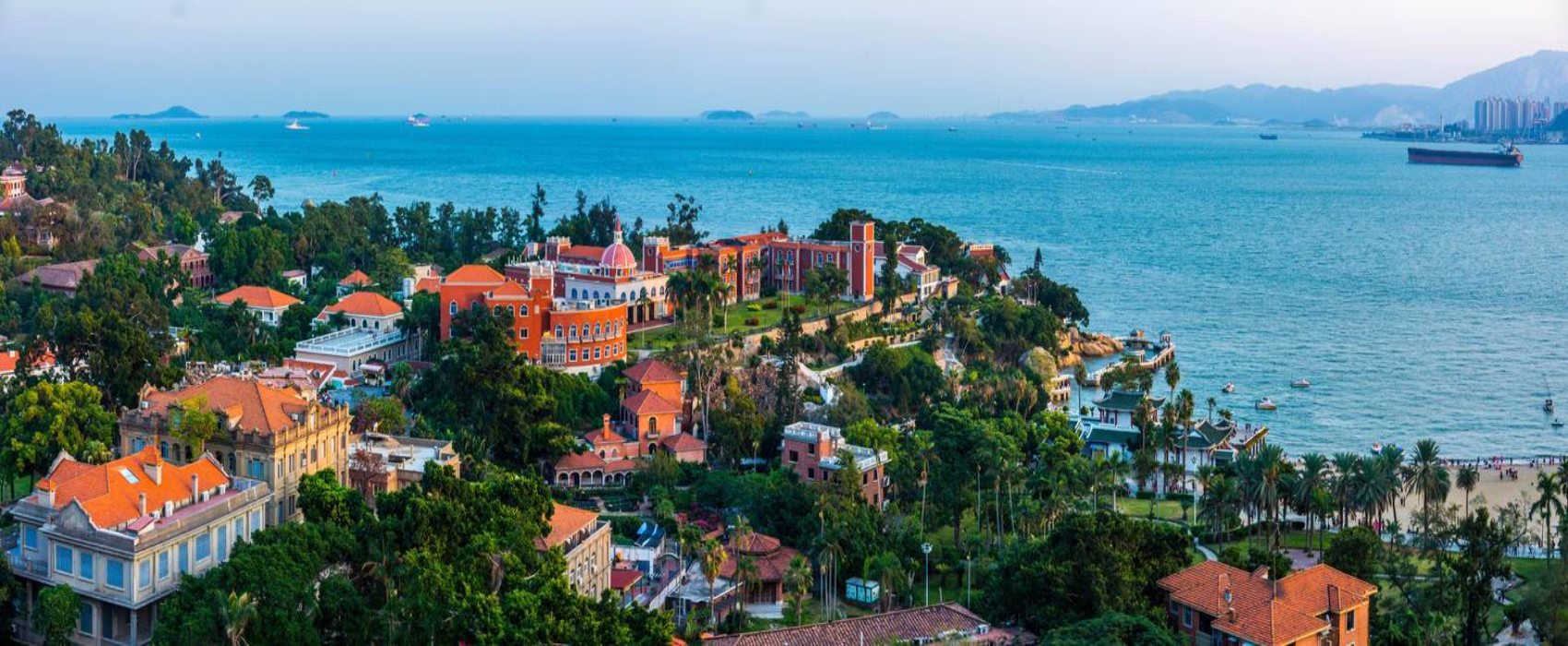

Gulangyu Island is located southwest of Xiamen City, accessible by ferry in approximately five minutes from the city. This scenic area is renowned for its picturesque natural landscapes, ancient relics, and diverse architecture. Designated as a National Scenic Area in China, it also ranks among Fujian Province’s top ten scenic spots. In July 2017, it was inscribed on the UNESCO World Heritage List.
1. History of Gulangyu Island
During the Ming Dynasty (1368–1644), the island was known as “Yuan Shazhou Island.” Its current name originates from the massive reefs encircling the island. At high tide, waves crashing against these reefs produce sounds resembling drumbeats, hence the name ‘Gulang’—meaning “drum waves” in Chinese. .
In the late Ming Dynasty, national hero Zheng Chenggong stationed his troops here. Following the Opium War in 1842, thirteen nations—including Britain, France, and Japan—established consulates, churches, and hospitals on the island, transforming Gulangyu into a joint concession. Japan occupied the island in 1942, maintaining control until the end of the War of Resistance Against Japan.

Gulangyu is home to approximately 20,000 permanent residents, all enjoying a comfortable and leisurely lifestyle. Only electric vehicles are permitted on the island, ensuring an environment free from the noise and pollution of internal combustion engines. On Gulangyu, you can experience a wealth of vibrant activities. Breathing in the fresh air while admiring lush trees and beautiful flowers, everyone feels as if they’ve stepped into paradise. Boasting classical, romantic European architecture, Gulangyu is truly a “museum of architecture.” Renowned for its thriving music scene, the island is also celebrated as the “Cradle of Musicians” and the “Island of Music.” To complement this rich musical atmosphere, a Piano Museum was established in 2000.
The coastal road encircling Gulangyu allows visitors to fully appreciate the island’s enchanting scenery.
Among the island’s many attractions, the most captivating are Sunlight Stone and Shuzhuang Garden.
2. Sunlight Rock
Sunlight Rock, situated in the south-central part of Gulangyu Island, stands at an elevation of 92.7 meters, making it the island’s highest point. Though not a towering mountain, it appears majestic and magnificent when viewed from afar. Sunlight Rock derives its name from a sun-shaped granite formation within the granite outcrop. Each sunrise bathes the granite within Sunlight Temple in golden light, causing the rock to shimmer brilliantly. Sunlight Rock
Below lies the Zheng Chenggong Memorial Hall, erected to honor this hero’s monumental achievements—he expelled Dutch colonizers and reclaimed Taiwan. Ascending the steep stone path, visitors encounter timeless inscriptions left by poets, the oldest dating back over 400 years. This area serves as the mountain’s primary cultural attraction. Continuing further, you’ll discover the ruins of Zheng Chenggong’s military training grounds. Near the training grounds, a massive rock spans two cliffs, forming a natural cave entrance known as “Gu Bishu Cave.” Cool breezes flow through, creating a refreshing and tranquil atmosphere. This spot offers an unparalleled vantage point to admire Gulangyu’s beauty, with panoramic views of Xiamen City unfolding below—including Nanputuo Temple, Xiamen University, and Huli Hill Battery.

3. Shuzhuang Garden
Originally built in 1931 as a private villa on Gulangyu’s southern shore, Shuzhuang Garden was converted into a public park in 1955. Divided into Canghai Garden and Zaoshan Garden, its design masterfully integrates three key elements of landscape architecture: concealment, borrowed scenery, and the interplay of stillness and movement.
The concept of concealment is evident: even at the garden entrance, the sea remains hidden. Yet, upon emerging from the bamboo grove, the ocean panorama suddenly unfolds before visitors. Ascending the Tide-Viewing Tower offers an even more sweeping vista of the majestic seascape.
Borrowing scenery refers to the artful utilization of natural landscapes. The owner skillfully leveraged the sloping terrain facing the sea, the reefs within the bay, and the contours of the coastline to construct bridges, pavilions, and towers at varying elevations. As elevation increases, the vista gradually expands from the narrow bay to the boundless ocean. Here, visitors can feel the gentle lapping of waves against the shore while overlooking other enchanting islands. Sunlight Rock and Hero Mountain (Yingxiong Mountain) also come into full view.
Another distinctive feature of this garden is the artful fusion of stillness and movement. Its unique layout seamlessly combines a rockery formed by labyrinthine caves with exquisitely crafted pavilions and towers on the hillside. Children playing and chasing each other through the caves symbolize vitality and energy, while people resting in the pavilions and towers create an atmosphere of tranquility and peace.
As a quintessential traditional Chinese garden, Shuzhuang Garden holds endless charm, compelling visitors to explore its depths.

Gulangyu also boasts other noteworthy attractions, such as Mingyue Garden, Scenic Garden, Yuyuan Garden, and the Xiamen Museum. Mingyue Garden, located in the southeastern part of the island, spans over 20,000 square meters (23,921 square yards). This sculpture garden, built to commemorate the national hero Zheng Chenggong, offers captivating scenery. The picturesque Scenic Garden, featuring a variety of Chinese and Western-style villas, has become a renowned tourist destination.
For more travel information, contact 365 China Travel guides. >>>apply now