

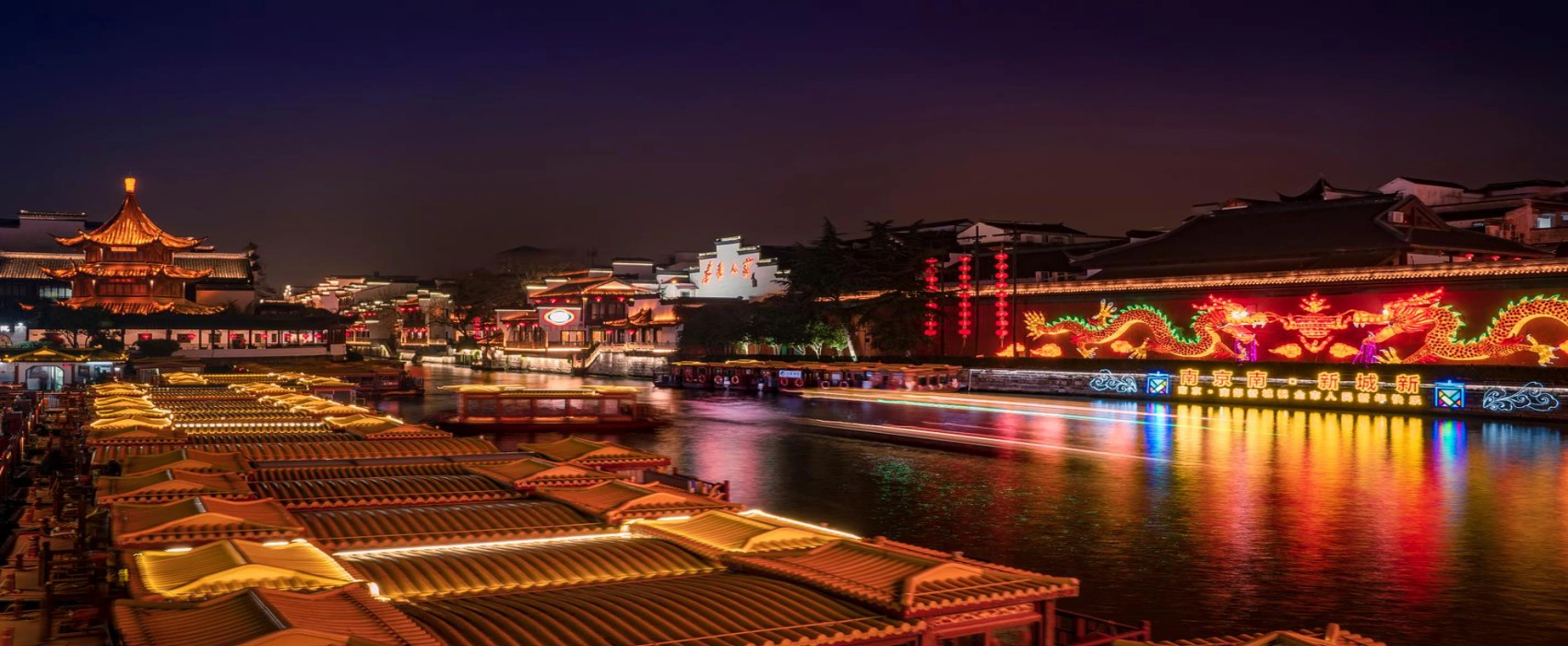

The Nanjing Confucius Temple is a place dedicated to venerating Confucius, the great ancient Chinese philosopher and educator, also known in Chinese as the Temple of the Master. Originally constructed in 1034 during the Song Dynasty (420-589 AD), the temple suffered repeated destruction and underwent multiple reconstructions. In 1937, it was burned down by Japanese invaders, sustaining its most severe damage. In 1984, with support from local authorities, the temple underwent reconstruction. During this lengthy process, the original complex was gradually expanded, ultimately evolving into a comprehensive structure blending architectural styles from the Ming and Qing dynasties. It now encompasses the Nanjing Confucius Temple, the Imperial Examination Museum, and the Imperial Academy (formerly the National Academy). To this day, both locals and visitors habitually refer to the entire complex as the Confucius Temple.

Before the Nanjing Confucius Temple, the Qinhuai River winds its way. On the south bank stands China’s longest screen wall, stretching 110 meters (about 120 yards) and built of brick and stone. The Hall of Great Achievement is a must-see. Standing 16.22 meters (about 53 feet) tall and 28.1 meters (about 30 yards) wide, it rests on a 1.5-meter (about 5-foot) high base. Inside, two highlights await: China’s largest statue of Confucius and 38 exquisite relief carvings in jade, gold, silver, and other materials, vividly depicting Confucius’ life. Outside the Hall of Great Achievement, you can also see a bronze statue of Confucius and white marble sculptures of his eight disciples.
Visiting the Jiangnan Imperial Examination Garden offers an in-depth look at how ancient Chinese governments selected officials—an experience not to be missed. Founded during the Southern Song Dynasty and developed through the Ming and Qing dynasties, it became China’s largest imperial examination academy by the Guangxu period of the Qing Dynasty. The garden’s main building is the three-story Mingyuan Tower, which housed 20,644 examination rooms. Today, it houses a museum dedicated to showcasing the ancient imperial examination system. Visitors can also experience simulated exams, immersing themselves in the joys and sorrows of the candidates.

The area surrounding Nanjing Confucius Temple is dotted with souvenir shops, snack stalls, restaurants, and teahouses, most featuring architectural styles reminiscent of the Ming and Qing dynasties. Here, you’ll find a diverse array of classic local snacks representing eight distinct flavors, catering to every palate and forming an integral part of Nanjing’s culinary heritage.
Just a short walk from the pedestrian street lies Bailuzhou Park, offering a stark contrast to the bustling surroundings with its serene and peaceful atmosphere. If you seek tranquility, head to Bailuzhou Park to experience another side of Nanjing.