

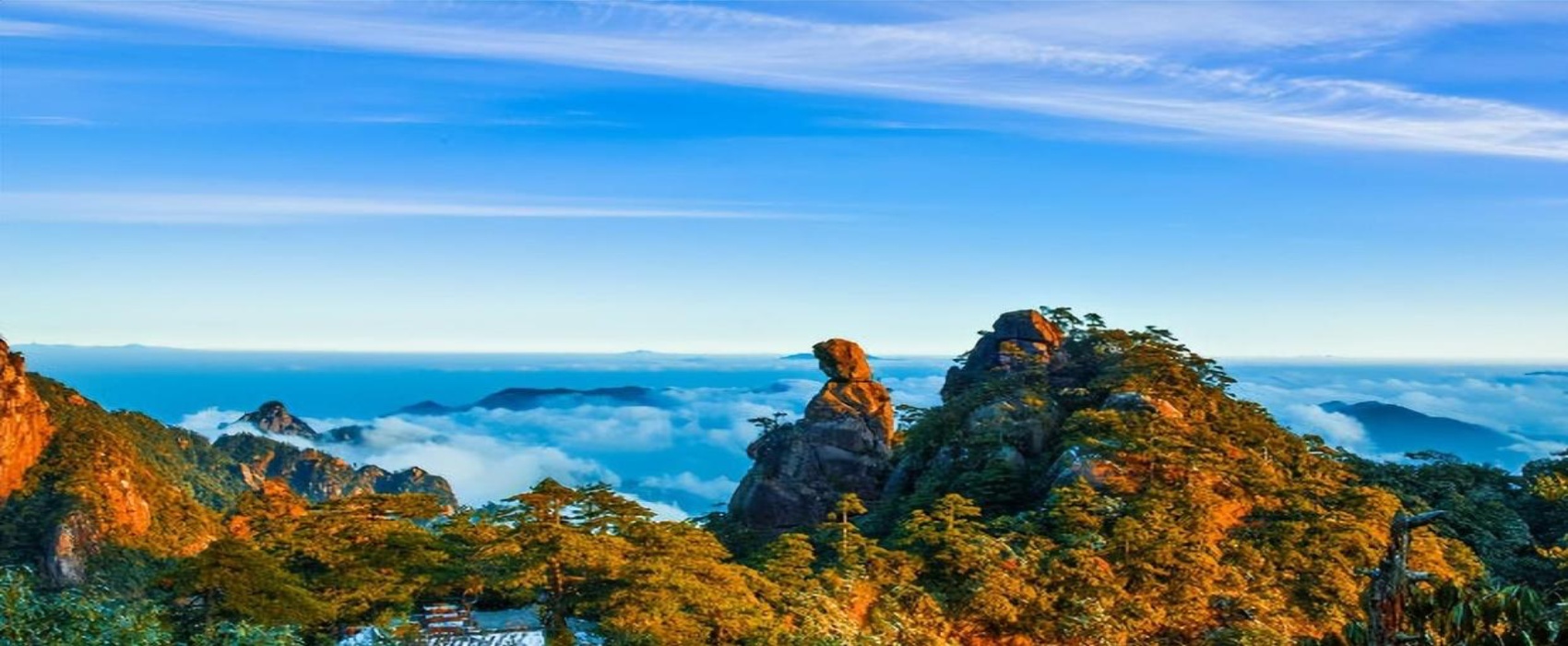

Sanqingshan is located in the northeastern part of Shangrao City, Jiangxi Province, and was inscribed on the World Heritage List at the 32nd Session of the UNESCO World Heritage Committee held on July 6, 2008. In addition, it has been designated as a National Key Scenic Area, a National AAAA-Level Tourist Area, a National Natural Heritage Site, and a National Geopark. Mr. Paul, President of the National Parks Foundation of the United States, remarked, “Sanqingshan is one of the world’s few gems and treasures.” *National Geographic China* magazine has named it one of “China’s Five Great Mountains,” and geologists from both China and the United States agree that it boasts “the most spectacular granite along the western Pacific coast.”
Sanqingshan is located 144 kilometers (89.48 miles) east of Quzhou City, Zhejiang Province; 78 kilometers (48.47 miles) west of Shangrao City; 115 kilometers (62.1 miles) south of Wuyishan City, Fujian Province; and 263 kilometers (163.42 miles) north of Huangshan City, Anhui Province. The scenic area covers a total of 220 square kilometers (84.89 square miles), with the main scenic area spanning 71 square kilometers (27.41 square miles). Yushan County is the closest county to Sanqing Mountain.
The three peaks—Yujing, Yuxu, and Yuhua—resemble the Taoist deities Yuqing, Shangqing, and Taqing lying side by side, hence the name Sanqingshan. It combines the beauty of Mount Huang, the grandeur of Mount Emei, the mist-shrouded landscapes of Mount Lu, and the rugged terrain of Mount Hua, showcasing a unique charm.
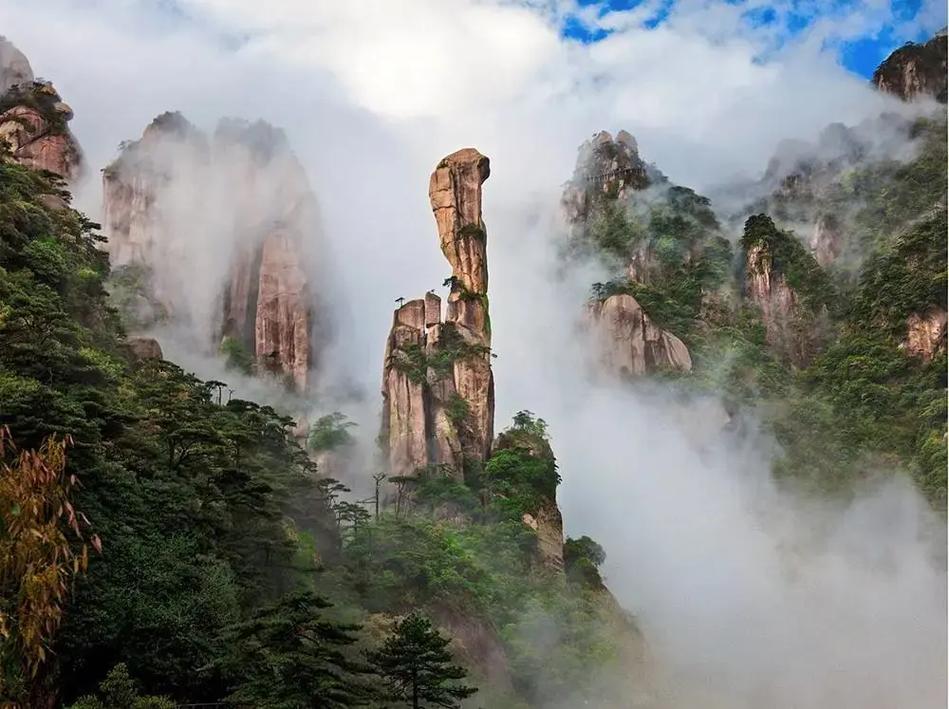
Granite landforms are the most valuable component of the Sanqing Mountain landscape. Sanqing Mountain boasts abundant granite landforms, stunning meteorological landscapes, ecological landscapes, rare flora and fauna, as well as lakes, waterfalls, and Taoist cultural landscapes. Visitors can admire lifelike rock formations here, such as the Statue of the Eastern Goddess, the Giant Python, the Nine-Layered Celestial Screen, the Thousand Peaks in Competition, the Three Dragons Rushing to the Sea, and the Guanyin in Joy. They can also witness various unique meteorological phenomena, the most famous of which include: sea of clouds, cloud waterfalls, the Sanqing Divine Light, the Five-Colored Path in the Clouds, and meteor showers. In winter, visitors can also experience a different landscape—snow-capped mountains. Since ancient times, Mount Sanqing has been an important spiritual center of Taoism, an ancient religious culture unique to China. Mount Sanqing boasts a complex of Taoist stone structures, such as Sanqing Temple, Longhu Palace, and the Wind and Rain Pagoda, which remain important relics of Taoist culture to this day.
Mount Sanqing boasts extraordinary biodiversity, with 2,373 species of higher plants and 1,728 species of wildlife, making it one of the most ecologically diverse regions in East Asia. Additionally, 144 species of flora and fauna are listed in the *China Red List of Species*, and 79 are designated as nationally protected species.
Mount Sanqing boasts breathtaking natural scenery, where pristine landscapes and virgin vegetation complement each other in a truly awe-inspiring display. Few places in the world can rival its beauty, showcasing the grandeur and magnificence of nature. We welcome you to visit and discover a place that is unique and beautiful not only for China but for the entire world.