

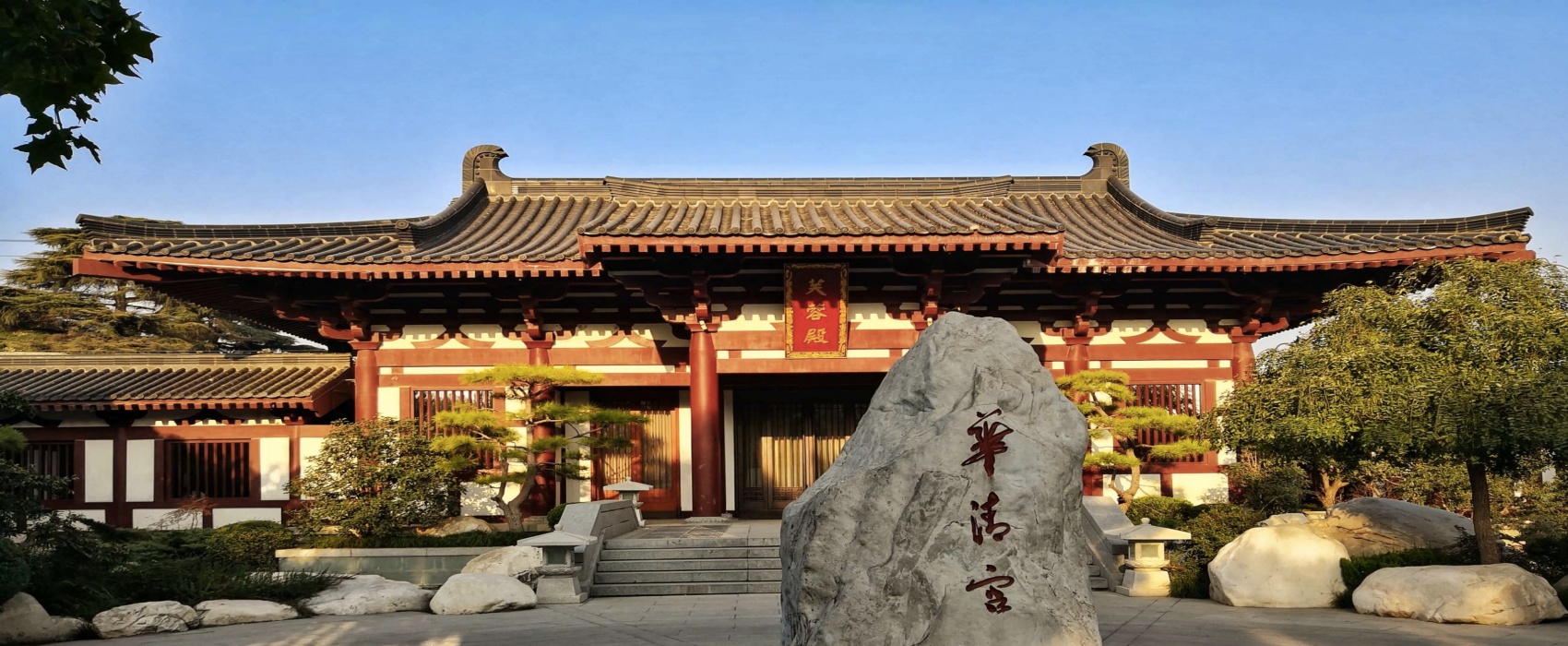

Huaqing Palace (also known as Huaqing Hot Springs) is located about 30 kilometers (19 miles) east of Xi’an, not far from the Terracotta Army, at the foot of Mount Li. It is one of China’s four great imperial gardens and served as a vacation resort for members of the ancient imperial family.
The original site, Liguang Palace, was first built during the reign of King You of the Western Zhou Dynasty (1046–771 BC) and was expanded by subsequent dynasties.
Huaqing Palace is renowned not only for its hot springs but also for the romantic yet tragic love story between Emperor Xuanzong of the Tang Dynasty and his most favored concubine, Yang Yuhuan (Emperor Xuanzong reigned from 618 to 907). During his reign, Emperor Xuanzong spent vast sums of money expanding Huaqing Palace, transforming it into a luxurious palace. Almost every autumn, Emperor Xuanzong would bring Yang Yuhuan here to enjoy their time together, returning to the capital only the following spring. Before Yang Yuhuan was executed by Emperor Xuanzong’s order following a rebellion, they spent many blissful moments here. If you’re interested, you can watch the large-scale stage production *The Long Lament* at Huaqing Palace to learn about their love story.
Upon arriving at the scenic area, you will be awestruck by the imperial hot spring pools, the ancient architecture, and the enchanting scenery of lakes and mountains. Even more surprising is that many staff members and visitors are dressed in traditional Chinese attire, transporting you back in time to the prosperous Tang Dynasty. Here are some highlights of the scenic area:
1. Tang Dynasty Imperial Pools
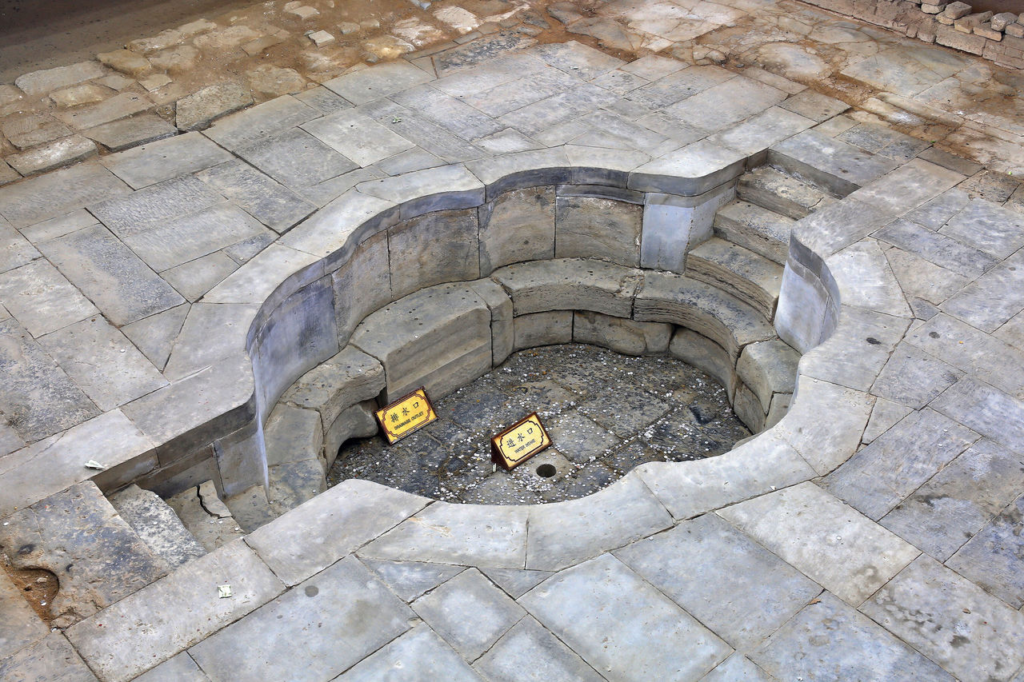
Five hot spring pools remain preserved within Huaqing Palace to this day: the Lotus Pool, the Begonia Pool, the Starry Sky Pool, the Upper Stone Pool, and the Crown Prince’s Pool. The Lotus Pool was Emperor Xuanzong’s private bath, shaped like a blooming lotus flower. The Begonia Pool, also known as the Consort’s Pool, is shaped like a begonia flower and was built for Yang Yuhuan. The Starry Sky Pool is said to have no roof, allowing bathers to admire the glittering night sky while soaking in the hot springs. The Upper Stone Pool was reserved for officials, while the Crown Prince’s Pool was, naturally, reserved for the crown prince.
To protect these hot springs from wind and rain, ancient-style structures were built over all of them except the Prince’s Pool. Next to the Prince’s Pool are two lotus-shaped buildings with multiple hot spring outlets. It is highly recommended to wash your hands and face here, as the hot spring water is said to be beneficial for the skin.
2. The Five-Room Building
Another famous structure at Huaqing Pool is the Five-Room Building, located within the Circular Garden. After the Eight-Nation Alliance captured Beijing in 1900, Empress Dowager Cixi sought refuge here; on December 12, 1936, during the world-renowned Xi’an Incident (also known as the “December 12 Xi’an Incident”), Chiang Kai-shek also stayed here temporarily. It was here that Chiang Kai-shek was kidnapped by two generals and forced to call upon the people of the nation to resist the invaders. Through the bullet holes still visible on the upper floor, visitors can perhaps still sense the intensity of the battle that took place here.
Inside the building, ancient furnishings are arranged in orderly rows, including the Yang Fei Pool—a scaled-down version of the Imperial Consort’s Pool originally built for Yang Guifei.
Despite its turbulent history, Huan Garden still retains its former charm. A 1,200-year-old pomegranate tree leans gently over the lake, while colorful koi swim among the water lilies. Additionally, performers dressed as newspaper boys, cigarette vendors, patriotic students, and passersby in cheongsam transport visitors back to the turbulent yet vibrant years of the Republic of China (1912–1949).
3. The Pear Garden and the Flying Frost Hall
Photo: The Pear Garden at Huaqing Pool is China’s most famous imperial theater. Emperor Xuanzong and his consort Yang Yuhuan created many songs and dances here, but the most famous of them, “The Song of the Lady’s Feathered Arts,” has long been lost. Today, the stage at the Pear Garden has been renovated to host interactive performances by actors.
To the west of the Pear Garden lies Feishuang Hall, also known as the Feishuang Chamber, which served as Emperor Xuanzong’s private quarters. The hall’s name originates from an intriguing legend: it is said that due to the presence of hot springs, the entire chamber remained warm even in winter. When snowflakes fell, they would instantly melt into frost.
4. Jiulong Lake
To the south of the Liyuan and Shuangfei Hall lies Jiulong Lake, covering an area of approximately 530 square meters (630 square yards). The lake is divided in two by the long Jiulong Bridge. In fact, there are only eight stone dragon sculptures on the bridge; the ninth dragon is carved beneath a pavilion on the lakeshore.
Nine Dragons Lake also serves as the stage for the musical drama *The Long Lament*. During the day, the stage sinks below the water’s surface, and at night, it rises for performances. Surprisingly, some of the highlights from the nighttime shows are also performed here during the day.
5. Mount Li
Mount Li is part of the Huaqing Palace Scenic Area and is famous for its beacon towers from the Western Zhou Dynasty. Standing atop Mount Li at an elevation of 1,300 meters (4,250 feet), you can enjoy a panoramic view of Huaqing Palace and the surrounding area.
6. Recommended Tour Routes
Without visiting Lishan Mountain: Wangjing Gate/West Gate – Furong Lake – Jiulong Lake – Imperial Pond – Xiuwen Hall or Liyuan Stage – Garden Loop (including Wufanglou) – Liyuan – Jinyang Gate/East Gate;
Touring the Entire Scenic Area: Wangjing Gate/West Gate – Take the cable car up Lishan Mountain – Old Wooden Palace – Beacon Tower – Loop around the Garden (including Wufanglou) – Imperial Pond – Jinyang Gate/East Gate.
7. Huaqing Palace offers a variety of spectacular performances
There are two main performances: the first is *The Song of Everlasting Sorrow*, mentioned earlier, which tells the love story of Emperor Xuanzong of Tang and Yang Guifei; the second is *The Xi’an Incident of December 12*, in which professional actors use close-up special effects to vividly portray the details of this famous event. In addition, smaller performances are staged throughout the site throughout the day.