

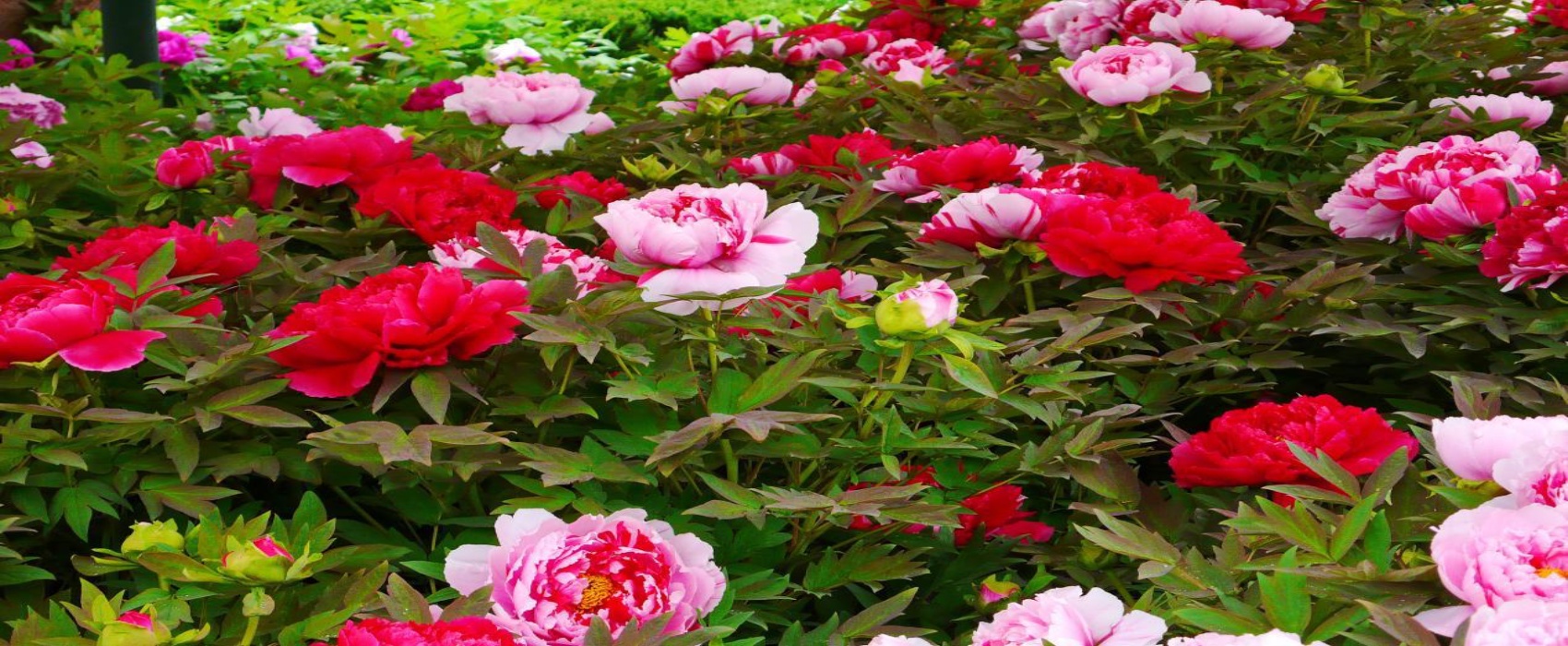

Completed in 2001, the China National Flower Garden is located on the south bank of the Luo River in Luoyang, Henan Province. Covering 255 acres, it is China’s largest peony garden. The garden features approximately 500,000 “Nine-Color” peonies, as well as over 2 million plants of more than 1,000 other varieties. Among them, a century-old peony named “Flower Goddess,” standing 2 meters tall, is a major attraction. The best time to visit the China National Flower Garden is from April through early May. Visitors can admire the peonies, pavilions, lakes, hills, and the garden’s distinctive architecture. The garden seamlessly blends the history of the Sui and Tang dynasties (581–907), traditional imperial garden art, and the beauty of the peonies. Below are the main areas of interest.
1. Peony Garden
This area features the “Fire-Baked Peonies” and a plaza displaying a giant gourd and three golden balls. Legend has it that these peonies were born from the elixir of immortality refined by fire by the Taoist sage Laozi, hence the name “Fire-Baked Peonies.”
2. Qiuweng Pavilion and Peonies
The design of this complex of pavilions and towers draws inspiration from the story of Qiuweng and the peonies. Qiuweng was a farmer who loved growing peonies and cared for them as if they were his own family. The area consists of five pavilions—one two-story and four single-story. Visitors can admire a variety of rare peony species here.
3. The Twin Qiao Peony Pavilion
Here, two pavilions merge into one, resembling a double-petaled peony—a rare flower featuring two distinct colors. During China’s Three Kingdoms period (220–265 AD), this type of peony was likened to the two beauties “Da Qiao” and “Xiao Qiao.”
4. Yanxiu Lake and Wuming Mountain
This lake covers more than 5 acres. Weeping willows sway along the shore, and fish glide through the water. Visitors can lie on the grass by the lake to feel the coolness of the spring water or stroll along the stone path that circles the lake. The hill is man-made and features numerous rugged caves. A waterfall cascades down the mountain, creating a magnificent scene that infuses the entire garden with vitality.
5. Butterfly Cultural Garden
This unique garden covers an area of over 2,000 square meters (2,400 square yards) and is designed to integrate butterfly elements into the landscape. During the Peony Cultural Festival, held annually from April through early May, visitors can admire the enchanting sight of more than 20,000 butterflies fluttering among the peony blossoms.
6. Luoyang Stone Carving Museum
It is Luoyang’s first and only private calligraphy museum. Founded by two brothers in 2012, it aims to preserve, protect, and display calligraphy artifacts from various regions and dynasties. Currently, the museum houses a collection of over 2,000 calligraphy artifacts and samples.