

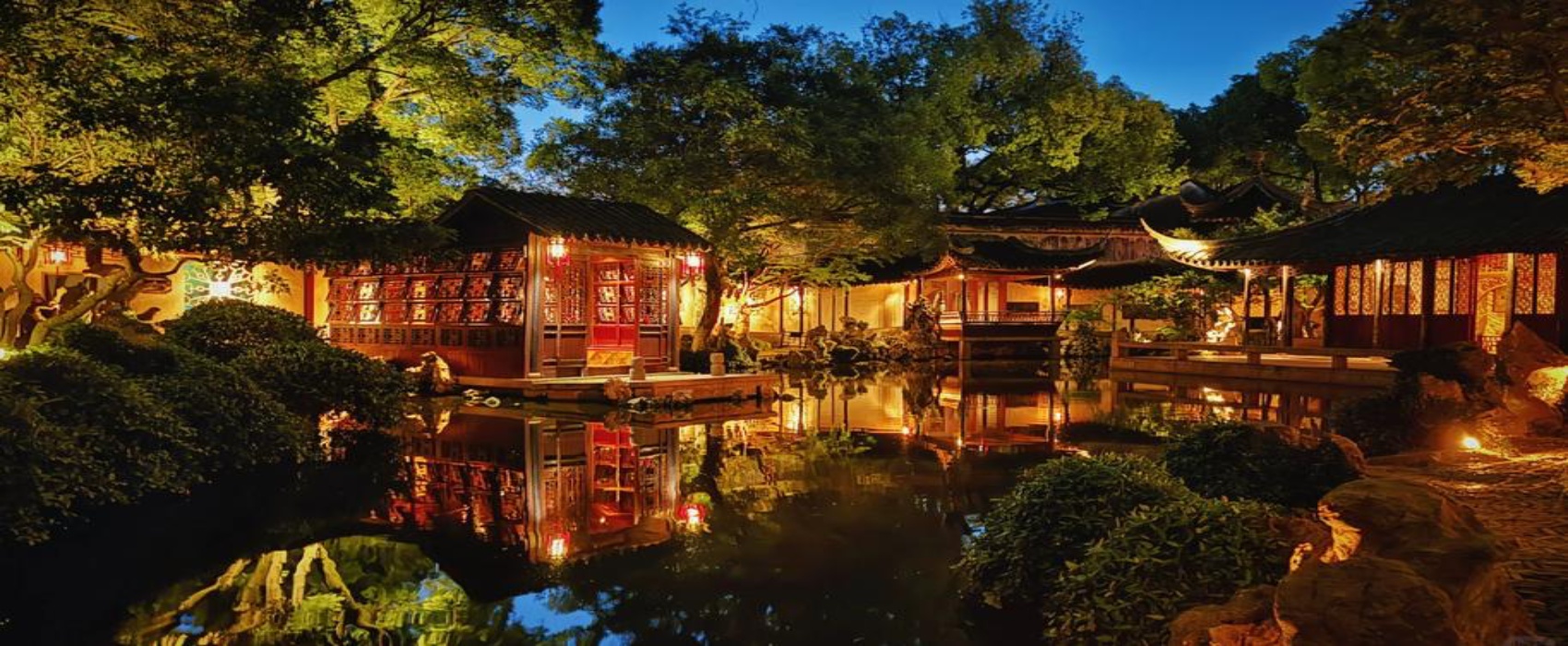

Zhouzhuang is one of China’s most renowned water towns, located in Kunshan City, just 30 kilometers (18 miles) southeast of Suzhou. It is celebrated for its rich cultural heritage, well-preserved ancient dwellings, picturesque water scenery, and vibrant local customs. During the Spring and Autumn Period (770–476 BC), the town belonged to the Yao City fiefdom and was known as Zhenfeng Village. In the Northern Song Dynasty (960–1127 AD), the devout Buddhist Zhou Diguo donated the town to Quanfu Temple in 1086. To honor the donor, the town was renamed Zhouzhuang.Within this 124-acre (0.5 square kilometer) area, 60% of the existing buildings date back to the Ming and Qing dynasties, spanning from 1368 to 1911. We’ll take the most convenient mode of transportation here—the cable car—to enjoy some breathtaking views one by one.
1. Twin Bridges
Surrounded and divided by lakes and rivers, the water town of Zhouzhuang features 14 stone bridges spanning its waterways, showcasing the unique charm of a water village. Among them, the Twin Bridges—comprising Shide Bridge and Yong’an Bridge—are the most renowned, regarded as symbols of this tranquil town. Constructed during the Wanli reign of the Ming Dynasty (1573-1619), the Twin Bridges are located in the northeastern part of Zhouzhuang. Shide Bridge runs east-west with an arched structure, while Yong’an Bridge extends north-south in a straight line. Spanning two intersecting rivers—Yinzi Creek and the North-South Stone Creek—the bridges connect at their midpoints, resembling an ancient Chinese key. In 1984, renowned painter Chen Yifei exhibited 38 works at a New York gallery named after Armand Hammer, chairman of Occidental Petroleum. Among the pieces displayed was “Memories of My Hometown,” depicting the Twin Bridges, which brought global attention to Zhouzhuang’s water town. This painting was selected for the first-day cover of the 1985 United Nations commemorative stamp.
2. Fuan Bridge
Fuan Bridge is located at the eastern end of Zhongshi Street and was first constructed in 1355 during the Yuan Dynasty (1271–1368). The bridge’s unique feature lies in the seamless integration of its single-arch structure with the bridge tower. There is no staircase connecting the first and second floors inside the tower; visitors must detour and use the stairs on the bridge to reach the upper level. Today, the tower serves as a tea house, restaurant, and shops, offering a delightful spot for people to relax and enjoy the scenery.
3. Shen House
Constructed in 1742, the Shen residence stands southeast of Fuan Bridge. This private estate belonged to descendants of Shen Wansan, the wealthiest man in southern China during the early Ming Dynasty. The entire complex, spanning over 0.7 acres (2,900 square meters), features Ming-style architecture. Over one hundred rooms are divided into three sections connected by arcades and corridors. The first section features a water gate and wharf where the Shen family moored boats and washed clothes. The central section includes the gate tower, tea room, and main hall. The brick gate tower is adorned with vivid, intricate carvings depicting historical narratives or auspicious blessings, making it a precious work of art. The tea room and main hall served as reception areas for guests, furnished with elegant and refined pieces. The final section comprises a two-story residential area, consisting of several buildings distinct in style from the main hall, offering a more comfortable and refined layout and atmosphere. The Grand Tang Building was the residence for the women of the household. The Small Tang Building houses a painted statue of the legendary deity Wan San. The building and rear hall also display cultural relics, including ancient folk musical instruments.
4. The Zhang Residence
Constructed during the Zhengtong era of the Ming Dynasty (1436–1449) by the Xu family, the Zhang Residence was acquired by the Zhang family in the early Qing Dynasty. Located south of Shuangqiao Bridge, it comprises over sixty rooms spanning approximately 1,800 square meters (0.44 acres). The Zhujing River flows through the estate, which is an elegant and refined residence featuring tranquil courtyards and ponds. Its deep halls also reflect the reclusive lifestyle of its former owners.
5.Milou Tower
Once called the De’s Tavern, Milou Tower perches next to Zhenfeng Bridge which is at the southwest corner of Zhouzhuang Ancient Town. It is famous for being a rallying place of the literators in old times. Numerous poets, songs and stories about Milou Tower are wide spread and make it more charming.
6. Chengxu Taoist Temple
Located on Zhongshi Street across from Puqing Bridge, Chengxu Taoist Temple was originally built between 1086 and 1093 during the Song Dynasty. Also known as Shengtang (Holy Hall), After multiple expansions, it has become one of the most renowned Taoist temples in Wuzhong District. Covering 1,500 square meters (1,800 square yards), its solemn structures—the Sacred Hall, Doumu Hall, Jade Emperor Pavilion, Wenchang Pavilion, and Sacred Site Pavilion—are masterpieces of Taoist architecture.
The attractions introduced above represent only a small fraction of the many scenic wonders in this water town. Beyond these historical sites, Chengxu Daoist Temple also boasts numerous folk legends, traditional customs, and historical tales—such as dragon boat racing, Grandma’s Tea, and the Wan San Family Banquet. These traditions stem from a long-standing civilization and history, serving as invaluable elements that leave visitors with unforgettable memories.