

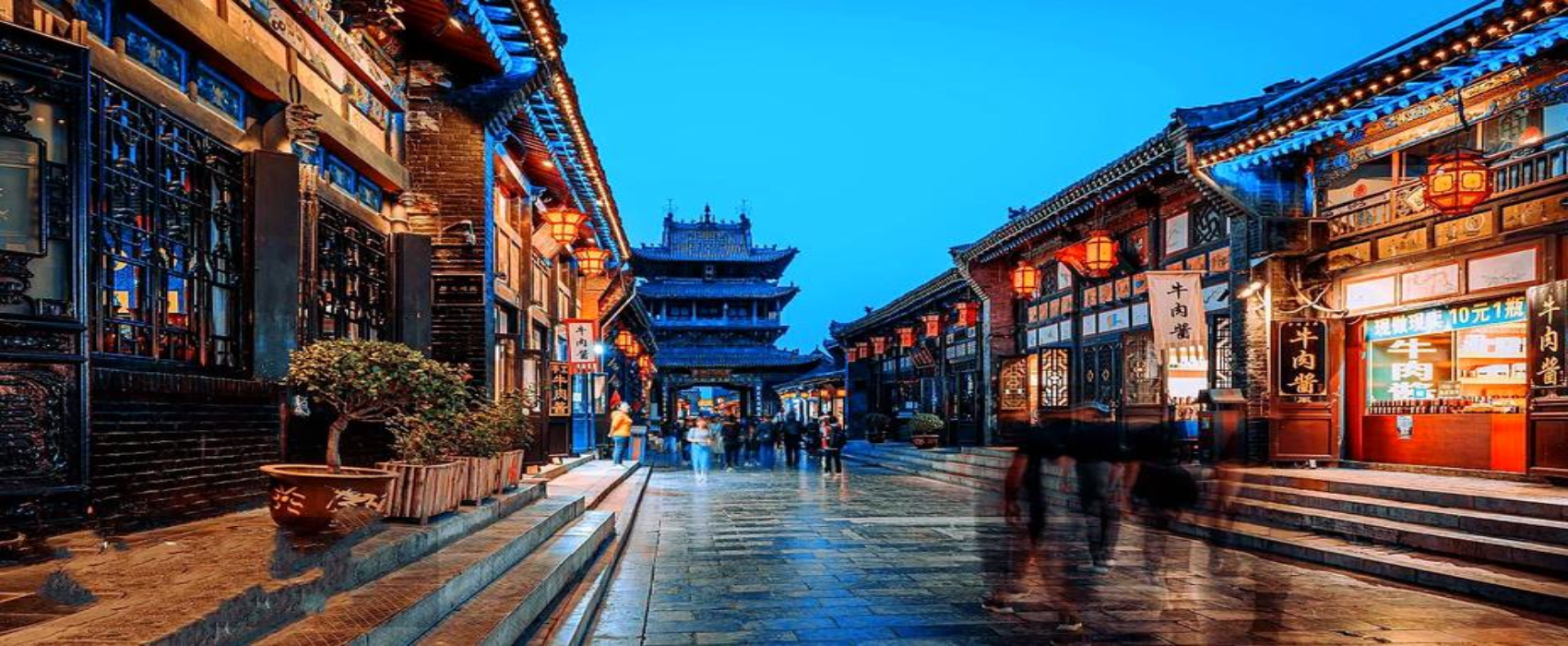

Pingyao embodies Shanxi’s former prosperity, and the soul of Pingyao lies within its ancient city. Founded during the Western Zhou Dynasty (1046–771 BC) and rebuilt in 1370, Pingyao Ancient City is now counted among China’s four best-preserved ancient towns, alongside Lijiang Ancient Town, Huizhou Ancient Town, and Longzhong Ancient Town. It lacks picturesque mountains, verdant hills, or crystal-clear lakes, yet its uniqueness lies in its exceptionally well-preserved ancient city, featuring imposing city walls, traditional dwellings, former guard barracks, historic shops, and even the remnants of ancient government offices. In 1997, it was inscribed on the UNESCO World Heritage List.
1. Ancient City Walls
Pingyao Ancient City, also known as the “Tortoise City,” derives its name from its walls resembling a tortoise shell. The Pingyao City Walls are a must-see attraction. The walls feature six gates, with four symmetrically positioned along the east and west sides, resembling the four legs of a turtle. The South Gate and North Gate correspond to the turtle’s head and tail, respectively. Viewed from above, the crisscrossing walls form the outline of a giant turtle, while the intersecting gates resemble the patterns on its shell.

2. Ancient Ming and Qing Street (South Street)
To glimpse the former prosperity of Pingyao Ancient City, the Ming and Qing Ancient Street is an absolute must-see. As the central axis of Pingyao Ancient City, it has remained the city’s most bustling commercial district for centuries. This approximately 450-meter-long street hosts around 80 ancient shops, including money exchange houses, pawnshops, security companies, and various handicraft workshops. Strolling along the Ming-Qing Street feels like stepping back in time to a bustling marketplace. Here, you can not only admire the traditional architecture but also purchase local specialties, snacks, and souvenirs.
3. The Old Rishengchang Bank
Located near the center of the ancient city, the Old Rishengchang Bank boasts nearly 200 years of history. As China’s first “bank,” it is hailed as the “Father of Chinese Banking.” During the Qing Dynasty (1644-1911), it controlled the lifeblood of the national economy, operating over 30 branches nationwide. Today, it serves as a museum dedicated to the history of banking, showcasing historical artifacts and local architectural styles. Here, visitors can explore the rise and fall of China’s banking industry and learn about the renowned Jin Merchants’ Association of Shanxi Province.

4. Ancient Security Companies
Ancient security companies can be regarded as early courier services, though they exclusively transported valuables like gold and silver for exchange shops and wealthy patrons. The proliferation of these security companies was a prominent feature of ancient cities. You can visit the most renowned one near the northern end of the Ming-Qing Ancient Street. Here, you can admire distinctive horse-drawn carriages, trunks, and other transport vehicles, gaining deeper insight into this organization. There’s also a dedicated training ground where security guards practiced martial arts. With various weapons as your backdrop, why not strike a kung fu pose and snap a commemorative photo?
5. Ancient Government Offices
Located on the west side of the Ming-Qing Ancient Street, the well-preserved ancient government compound stands as China’s largest official residence, covering an area of 31,000 square yards (25,920 square meters). During the Ming and Qing dynasties (1368-1911), a total of 149 local officials worked and resided here. The core area of the compound is the solemn and dignified courtroom. If you’re fortunate, you might witness a reenactment of an ancient trial in the courtroom. Deep within the compound lies the prison, where dim lighting may evoke a sense of eeriness. You might even encounter dilapidated beds, prisoners’ uniforms, and rusted instruments of punishment.

6. City God Temple
Located on the east side of Ancient Ming-Qing Street, the City God Temple is a sacred site where people worship the City God, God of Wealth, and Kitchen God. Distinguished officials and commoners who made significant contributions to the local community are also honored here. This traditional temple spans 8,800 square yards (7,340 square meters) and features numerous exquisite pavilions and towers. Colorful glazed tiles from the Ming and Qing dynasties shimmer brilliantly under the sun, enhancing its majestic grandeur.
7. Confucius Temple
This is a must-visit site for paying homage to Confucius, the founder of Confucianism. Covering 10,000 square yards (8,361 square meters), it stands as China’s best-preserved Confucius temple. In ancient times, it also served as a national academy. Back then, most scholars aspired to become government officials, and passing the imperial examinations was their sole pathway to such positions. Exhibits within the temple’s five courtyards detail the evolution and procedures of the ancient imperial examinations.