

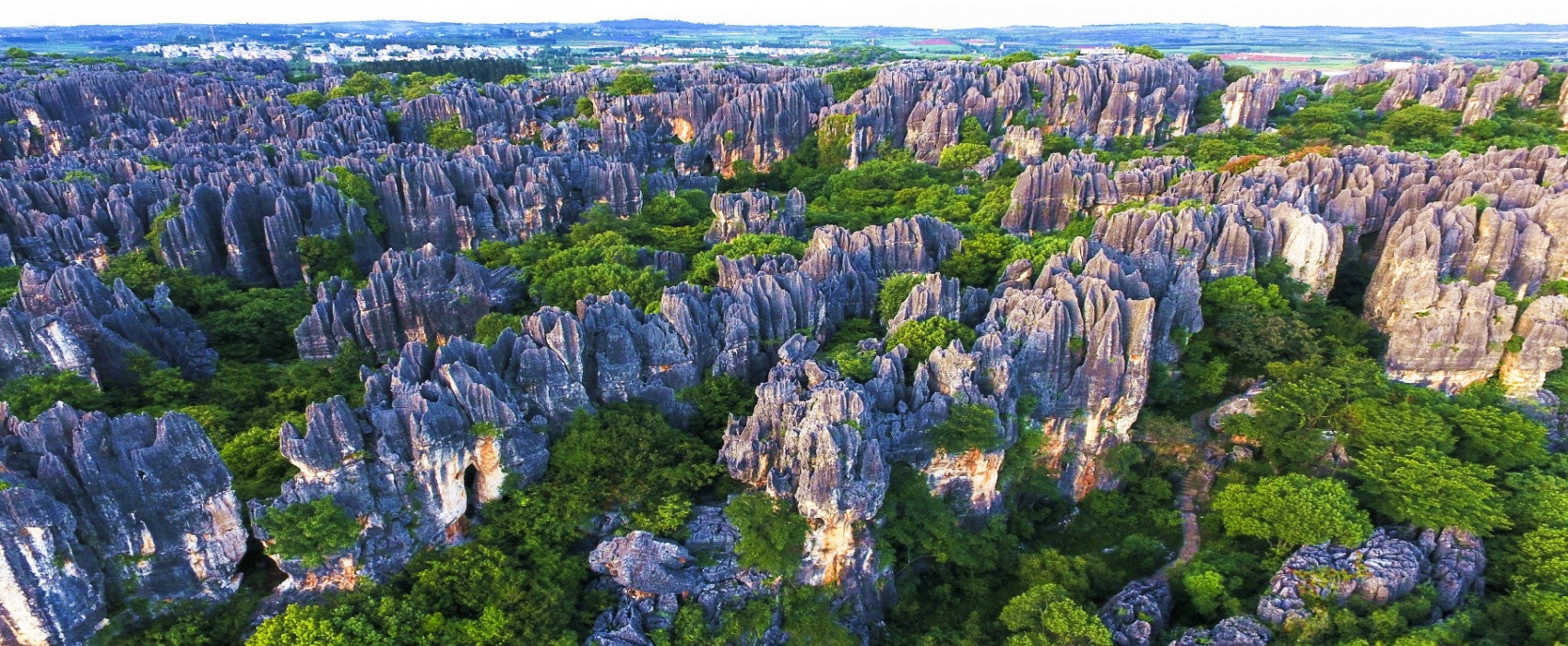

Kunming Stone Forest, known in Chinese as Shilin, is a spectacular limestone formation and a prime example of karst topography in southern China. Since the Ming Dynasty (1368–1644), it has been hailed as “the world’s greatest natural wonder” and stands as one of Yunnan’s most significant tourist attractions. As a local elder often says, if you visit Kunming without seeing the Stone Forest, your trip to Kunming will have been in vain.

1. Overview of China’s Stone Forest
♥Location: Shilin Yi Autonomous County, 120 kilometers (75 miles) from Kunming, a 3-hour drive.
♥Area: 400 square kilometers (150 square miles)
♥Major Attractions:-Small and Large Stone Forests、Naigu Stone Forest、 Zhiyun Cave、Changhu Lake、Moon Lake、Diedeshui Waterfall、Qifeng Cave、Guishan Mountain

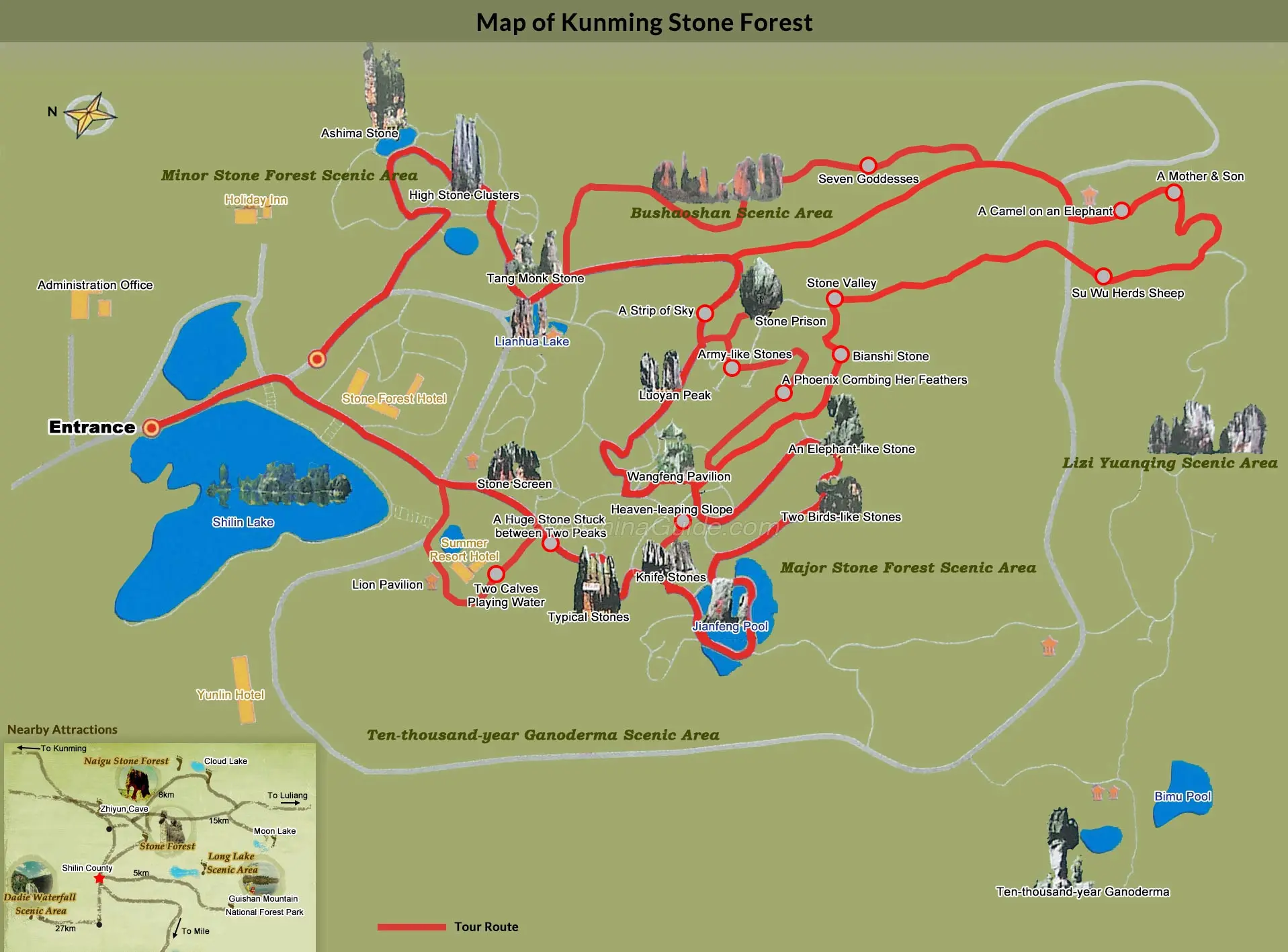
2. Sightseeing Routes and Popular Attractions
Strolling through this area, visitors marvel at the natural stone sculptures and become captivated by the intricate rock formations. The majestic and unique steep terrain has created countless labyrinthine landscapes, including:
The Grand Stone Forest, the Small Stone Forest, and the Naigu Stone Forest, each featuring rocks of distinct shapes. Here, you’ll find animal, plant, and human-like figures—some graceful, others rugged—each vividly lifelike and uniquely distinctive.
The Zhiyun Cave Underground Stone Forest spans multiple caverns, covering a total area of approximately three square kilometers (720 acres).
Qifeng Cave comprises Pengfeng Cave, Hongxi Spring, and an underground river. From August to November each year, fierce winds sweep through the cave every 30 minutes, lasting 2 to 3 minutes.
Changhu Lake is a karst lake stretching three kilometers (two miles) in length, yet only 300 meters (0.2 miles) wide. The lake is dotted with underwater stalagmites and stalactites, and features a small island at its center. The source of the Dadi Waterfall, the Ba River, is a tributary of the Nanpan River. During the rainy season, the waterfall plunges 88 meters (288 feet) with a flow rate of up to 150 cubic meters (196 cubic yards) per square inch.
3. How were China’s stone forests formed?
Geologists describe stone forests as quintessential examples of karst topography. Approximately 270 million years ago during the Carboniferous Period of the Paleozoic Era, this region was a vast ocean. Over time, movements in the lithosphere gradually caused the sea to recede, leaving limestone formations exposed. Through continuous natural erosion, this area eventually evolved into its present landscape.
Many beautiful legends originate from this magical land, passed down through generations by the local Sani people (a branch of the Yi ethnic group). Among them, the story of Ahima—a beautiful, intelligent, and kind-hearted Sani girl—and her faithful love remains the most widely circulated, having been told for thousands of years. The Sani celebrate their ethnic festival, the Torch Festival, annually on the 24th day of the sixth lunar month. During the festival, they perform traditional activities such as wrestling, bullfighting, pole climbing, dragon and lion dances, and the Axiyue dance. The area is filled with an exceptionally joyful and festive atmosphere, making it even more enchanting than usual.
The Stone Forest—those marvels sculpted by nature’s extraordinary craftsmanship—remains a breathtaking natural wonder that never ceases to amaze visitors.